Granular Activated Carbon Supplier: Why Particle Size Matters in Fixed-Bed Adsorption
When selecting activated carbon for a fixed-bed treatment system, buyers often focus on iodine number, surface area, or adsorption capacity. These properties matter, but physical characteristics can also influence how carbon behaves inside the treatment bed.
One important factor is particle size.
Particle size affects pressure drop, mass transfer, flow distribution, adsorption kinetics, and carbon handling. Choosing the right size is therefore not simply about selecting finer or coarser granules. It is about finding a specification that suits the application and the treatment system.
For buyers evaluating a Granular Activated Carbon Supplier, understanding this relationship can make carbon selection more precise and application-focused.
What Is Particle Size in Granular Activated Carbon?
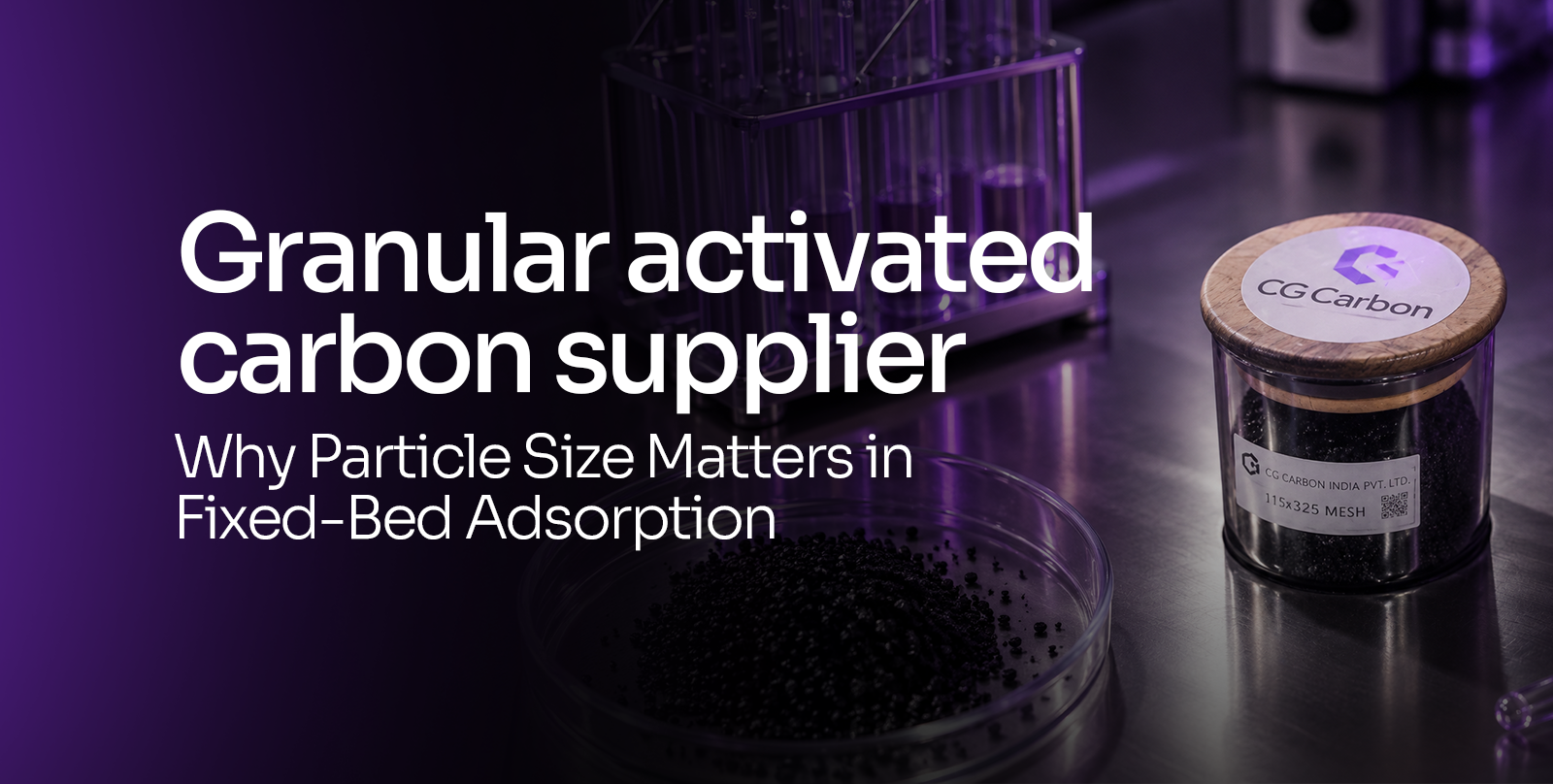
Granular activated carbon is available in different particle size ranges, commonly specified through mesh sizes or millimetres.
Particle size refers to the physical dimensions of the individual carbon granules within the bed. These dimensions influence how fluid moves through the bed and how contaminants travel through the carbon particles.
Smaller particles generally provide shorter diffusion paths. Larger particles can offer different hydraulic and mechanical characteristics.
Neither is universally better.
The appropriate size depends on the application, contaminant characteristics, system configuration, and operating conditions.
How Particle Size Affects Adsorption
Adsorption occurs when contaminants move from the fluid phase onto the surface and pore structure of activated carbon.
Before reaching internal adsorption sites, contaminant molecules must move through the carbon particle. Particle size can influence the distance they need to travel.
Smaller particles can provide shorter internal diffusion paths. Under suitable conditions, this may support faster mass transfer and adsorption kinetics.
However, adsorption performance cannot be determined by particle size alone.
Carbon pore structure, contaminant properties, concentration, temperature, fluid characteristics, and operating conditions also influence adsorption.
This is why particle size should be considered alongside the other properties of the carbon.
Particle Size and Pressure Drop
Pressure drop is an important consideration in fixed-bed systems.
As fluid passes through a packed carbon bed, resistance develops around the particles. Smaller particles generally create greater resistance because the spaces between individual granules are smaller.
As particle size decreases, pressure drop can therefore increase under comparable bed and flow conditions.
This can affect pumping requirements and system operation.
For an existing treatment system, switching to a significantly finer carbon without considering hydraulic limitations may create operational challenges.
A suitable particle size should therefore balance adsorption requirements with the pressure-drop limits of the system.
The Role of Mass Transfer
Mass transfer describes how contaminants move from the bulk fluid toward and into the activated carbon.
This process influences how quickly adsorption capacity can be utilised.
Smaller carbon particles can reduce the distance that contaminants need to travel within each particle. This may support faster access to adsorption sites under suitable operating conditions.
Larger particles can have longer diffusion paths.
However, the actual impact depends on the complete adsorption system. Particle size interacts with pore structure, contaminant molecule size, concentration, temperature, flow conditions, and other factors.
So, particle size should not be treated as a standalone measure of adsorption performance.
Finding the Right Balance
The goal is not to choose the smallest carbon particle available.
The goal is to choose a particle size that fits the treatment application.
For some systems, faster mass transfer may be an important consideration. For others, pressure drop, mechanical strength, bed configuration, or handling requirements may carry greater importance.
This balance becomes especially relevant in continuous fixed-bed applications where carbon remains in service for extended periods.
The right selection considers both adsorption behaviour and hydraulic performance.
Particle Size Is Not Pore Size
Particle size and pore size are two different properties.
Particle size refers to the physical dimensions of the carbon granules.
Pore size refers to the internal pore network within those granules.
A relatively large carbon particle can contain a highly developed pore structure. Similarly, reducing the external particle size does not automatically change the internal pore structure.
Adsorption depends heavily on how the carbon’s pore structure interacts with the target molecules.
For this reason, buyers should evaluate particle size together with relevant adsorption and physical properties.
What Buyers Should Discuss With a Supplier
When choosing a Granular Activated Carbon Supplier, buyers should provide information about the actual treatment application.
Useful details may include:
- Treatment medium
- Target contaminants
- Inlet concentration
- Required outlet quality
- Flow conditions
- Bed dimensions
- Operating temperature
- Pressure limitations
- Required service life
- Carbon replacement or reactivation plans
This information gives the supplier a better understanding of the application.
It also helps move the discussion beyond a standard carbon specification and towards a more suitable product selection.
CG Carbon’s Approach to Carbon Selection
CG Carbon manufactures activated carbon solutions for industrial applications, with a focus on application-specific requirements.
As a Granular Activated Carbon Supplier, CG Carbon supports customers in selecting carbon based on factors such as contaminant characteristics, treatment requirements, and the intended operating environment.
The focus is not simply on supplying a particular particle size.
Particle size needs to work alongside the carbon’s adsorption characteristics and physical properties. Depending on the application, considerations such as pore structure, hardness, ash content, and particle size distribution may all be relevant.
This application-focused approach helps customers evaluate carbon based on how it is expected to perform within their treatment process.
Why Particle Size Distribution Matters
The stated particle size range is important, but consistency within that range also deserves attention.
A broad or inconsistent distribution can influence how particles pack inside the bed. This can affect void spaces, fluid movement, pressure drop, and overall bed behaviour.
Consistent granular characteristics can therefore contribute to more predictable handling and system performance.
For industrial applications, this becomes particularly relevant when carbon is used in larger treatment beds or under continuous operating conditions.
A Granular Activated Carbon Supplier should be able to provide relevant particle size specifications and discuss how they relate to the intended application.
Selecting Carbon for Fixed-Bed Applications
Particle size is only one part of the carbon-selection process.
A complete evaluation should consider:
Adsorption properties
How effectively the carbon can interact with the target contaminants.
Pore structure
Whether the available pore network is suitable for the molecules being treated.
Particle size
How the granule dimensions may influence mass transfer and hydraulic behaviour.
Mechanical strength
How well the carbon withstands handling and operating conditions.
System compatibility
Whether the selected carbon fits the equipment and operating limitations.
At CG Carbon, these factors can be considered when supporting customers with carbon selection for their specific treatment requirements.
Conclusion
Particle size plays an important role in fixed-bed adsorption. It can influence mass transfer, pressure drop, bed behaviour, and carbon handling.
But smaller does not automatically mean better.
The right particle size depends on the relationship between the carbon, contaminants, and treatment system.
For buyers, the important question is not simply:
“What particle size should we buy?”
It is:
“Which particle size is appropriate for our application?”
Working with a Granular Activated Carbon Supplier that understands both carbon characteristics and application requirements can help customers make a more informed selection.
For CG Carbon, the focus is on supplying activated carbon suited to the customer’s specific requirements while providing practical guidance around carbon selection.
Because effective carbon selection starts with understanding how the carbon needs to perform inside the process.