Granular vs Pelletized Activated Carbon for Air Treatment
Industrial air treatment helps control odours, manage volatile organic compound (VOC) emissions, and improve air quality. Activated carbon is widely used in these applications because its porous structure captures suitable contaminants from air and gas streams through adsorption.
Choosing between granular and pelletized carbon depends on particle shape, airflow, pressure drop, dust generation, and system design. Understanding Granular vs Pelletized Activated Carbon for Air Treatment helps industries identify a product that matches their contaminants, equipment, and operating conditions.
What Is Activated Carbon for Air Treatment?
Activated carbon is a porous material with an extensive internal surface area. During air treatment, suitable gas molecules attach to surfaces within its pores through adsorption. Unlike absorption, which involves a substance entering the bulk of another material, adsorption occurs primarily at surfaces.
Activated carbon is used in industrial ventilation, odour control, solvent recovery, and selected gas purification applications. Its performance depends on pore structure, contaminant characteristics and concentration, temperature, humidity, and contact time.
The physical form of the carbon also matters because it influences particle packing and the way air passes through the adsorption bed.
What Is Granular Activated Carbon?
Granular activated carbon (GAC) consists of irregularly shaped particles available in different size ranges. It is commonly used in fixed-bed filtration systems for treating liquids and gases.
In air treatment, granular carbon is packed into a filter housing or adsorption vessel. As contaminated air passes through the bed, suitable gaseous contaminants interact with the carbon’s porous surface and may be retained through adsorption.
Key Benefits of Granular Activated Carbon
- Flexible filter design
Granular carbon can be used in various filter configurations designed for granular media. The appropriate particle size and bed depth depend on equipment dimensions, airflow requirements, and treatment objectives.
- Application-specific selection
Different granular grades offer different physical and adsorption characteristics. This allows industries to evaluate products according to the target contaminants and operating conditions.
- Compatibility with existing systems
Granular carbon may be preferred when an existing vessel or filter is specifically designed for granular media. Retaining a compatible configuration can help avoid unnecessary equipment modifications.
However, irregular particle shapes and variations in particle size can influence bed packing, airflow distribution, and pressure drop. These factors should be considered during system design.
What Is Pelletized Activated Carbon?
Pelletized activated carbon is manufactured into cylindrical particles with relatively uniform diameters and lengths. It is commonly considered for gas-phase applications where particle dimensions, bed structure, and mechanical properties are important.
Pelletized activated carbon for air treatment can be suitable for controlling selected VOCs and odour-causing compounds when its adsorption characteristics match the gas stream. Its performance depends on the carbon grade, operating conditions, and compatibility with the treatment equipment.
Key Benefits of Pelletized Activated Carbon
- More uniform particle geometry
The consistent dimensions of pellets can help engineers characterise bed packing and design airflow paths in systems intended for pelletized media.
- Suitable airflow characteristics
Pelletized carbon may provide suitable pressure-drop characteristics in a properly designed system. Actual performance depends on pellet dimensions, bed depth, gas velocity, and packing conditions.
- Mechanical strength considerations
Grades with suitable hardness and attrition resistance can help limit particle breakdown during handling and operation. Relevant product specifications should be reviewed to assess this characteristic.
- Compatibility with industrial gas treatment
Pelletized carbon may be suitable for industrial gas treatment applications involving VOCs and odours when the selected grade meets the process requirements. Evaluating pelletized activated carbon for air treatment should include adsorption properties, particle dimensions, and the operating limits of the system.
Granular vs Pelletized Activated Carbon: Key Differences
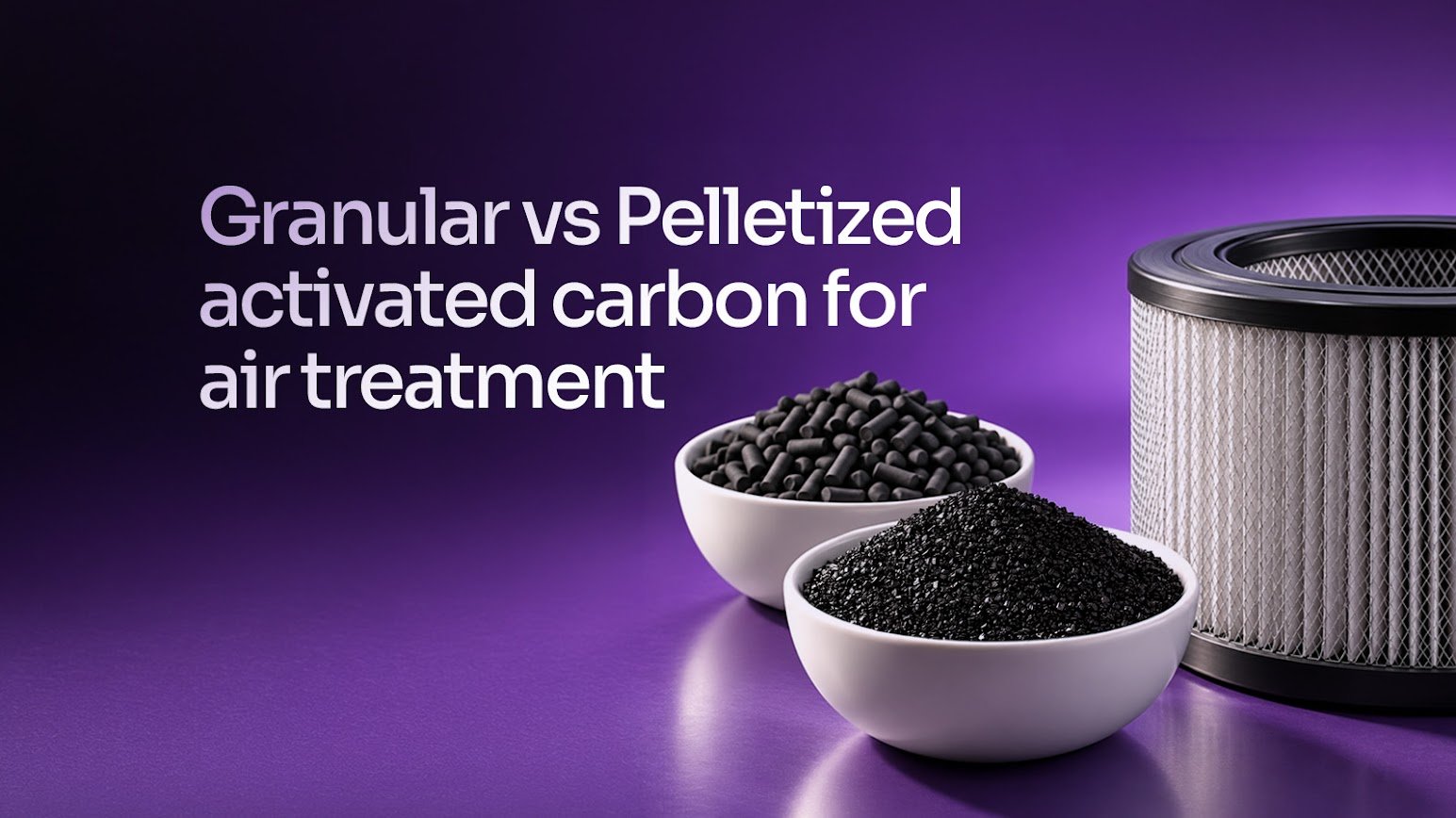
The main difference between granular and pelletized activated carbon lies in their particle shape and how they behave within an adsorption system. Granular activated carbon consists of irregularly shaped particles, while pelletized activated carbon is manufactured into cylindrical forms with relatively uniform dimensions. These physical differences influence bed packing, airflow, pressure drop, and dust generation.
Granular carbon may be preferred for existing filtration systems designed for granular media, particularly when a suitable particle size and adsorption capacity meet the application requirements. However, variations in particle size and shape can affect how the carbon packs within the bed and how air moves through it. Pelletized carbon, on the other hand, offers more uniform particle geometry, which can help engineers design and evaluate packed beds with defined dimensions. Its pre
pressure-drop characteristics depend on pellet diameter and length, bed depth, airflow velocity, and packing conditions.
Dust generation is another consideration when selecting between the two forms. Both granular and pelletized carbon can produce fines during handling and operation, depending on their mechanical strength, attrition resistance, and handling conditions. The appropriate choice therefore depends on the required adsorption performance, equipment design, airflow requirements, and product specifications rather than particle shape alone.
Neither form is universally better. Smaller particles can offer shorter diffusion paths but may increase flow resistance, while larger particles can reduce resistance under suitable conditions but may affect mass-transfer performance. The final selection should consider the complete treatment system.
How to Choose the Right Activated Carbon for Air Treatment
Once the preferred physical form has been identified, several factors help determine the suitable carbon grade.
1. Identify the Target Contaminants
VOCs, hydrocarbons, and odour-causing compounds have different adsorption characteristics. Their molecular properties, concentrations, and interactions with other gas components influence how effectively they can be captured.
Identifying the gas composition helps determine which carbon grades warrant further evaluation.
2. Evaluate Operating Conditions
Temperature, relative humidity, gas flow rate, and contaminant concentration all affect adsorption performance. High humidity may reduce adsorption for certain compounds, while higher temperatures can reduce the capacity of many physically adsorbing carbons.
These conditions should be assessed alongside the product’s technical specifications.
3. Check System Compatibility
The carbon must suit the dimensions and operating limits of the treatment equipment. Bed depth, airflow velocity, particle size, pressure-drop limits, and media-retention arrangements should be reviewed together.
For applications considering pelletized activated carbon for air treatment, the pellet dimensions must be compatible with the vessel design and required airflow conditions.
4. Review Product Specifications and Maintenance Needs
Relevant specifications may include particle dimensions, adsorption-related properties, moisture content, hardness, and attrition resistance, where available for the selected grade.
Dust generation, handling requirements, contaminant loading, and replacement intervals should also be considered. Actual service life depends on the application and operating conditions rather than particle shape alone.
How CG Carbon Can Support Product Selection
Selecting activated carbon for air treatment requires a clear understanding of the contaminants, operating conditions, and equipment design. Comparing particle shapes is only one part of the process.
CG Carbon is an established Indian manufacturer of coconut shell-based activated carbon, recognised for its diverse product portfolio and focus on industrial purification solutions. Its range includes granular and pelletized activated carbon, along with specialised impregnated carbons. With research and development capabilities, laboratory facilities, and a commitment to product quality, CG Carbon brings technical expertise to the evolving needs of industrial air and gas treatment.
For industrial buyers, product evaluation should begin with the target gas composition, operating temperature and humidity, airflow rate, and the design of the existing adsorption bed. These details help establish which product specifications need to be assessed. CG Carbon’s range of product grades and published technical specifications provides a starting point for evaluating suitable options against these requirements.
When evaluating CG Carbon’s available grades, buyers should review the applicable technical datasheets and confirm relevant parameters such as particle dimensions, adsorption properties, and mechanical strength where specified. Application-specific testing may also be necessary when performance requirements are demanding. By combining its product range, manufacturing expertise, and technical capabilities, CG Carbon aims to help industries identify activated carbon solutions suited to their purification needs.
Conclusion
Granular and pelletized activated carbon both play important roles in industrial air treatment. Granular activated carbon remains a widely used choice because it is compatible with many established fixed-bed filtration systems and is available in different particle sizes to suit various application requirements. Its versatility and suitability for conventional filtration setups make it a practical option across many industrial applications.
Pelletized carbon also offers advantages for systems designed around cylindrical media, particularly where uniform particle dimensions and specific airflow characteristics are important. The suitability of either form depends on the target contaminants, adsorption performance, airflow requirements, pressure drop, and equipment design.
Selecting the right activated carbon grade requires careful consideration of these factors alongside verified product specifications. By understanding the demands of the application, industries can identify a suitable solution, whether granular media or pelletized activated carbon for air treatment, to support effective and reliable purification.