Pelletized Activated Carbon Supplier: How Pellet Size and Structure Influence Gas-Phase Adsorption
In industrial gas treatment, activated carbon is often used to remove VOCs, odours, hydrocarbons, and other unwanted compounds from process air and gas streams. For these applications, carbon geometry matters. Pelletized activated carbon is manufactured into cylindrical or similarly shaped particles with controlled dimensions. Unlike irregular granular carbon, pellets offer a more consistent shape and […]
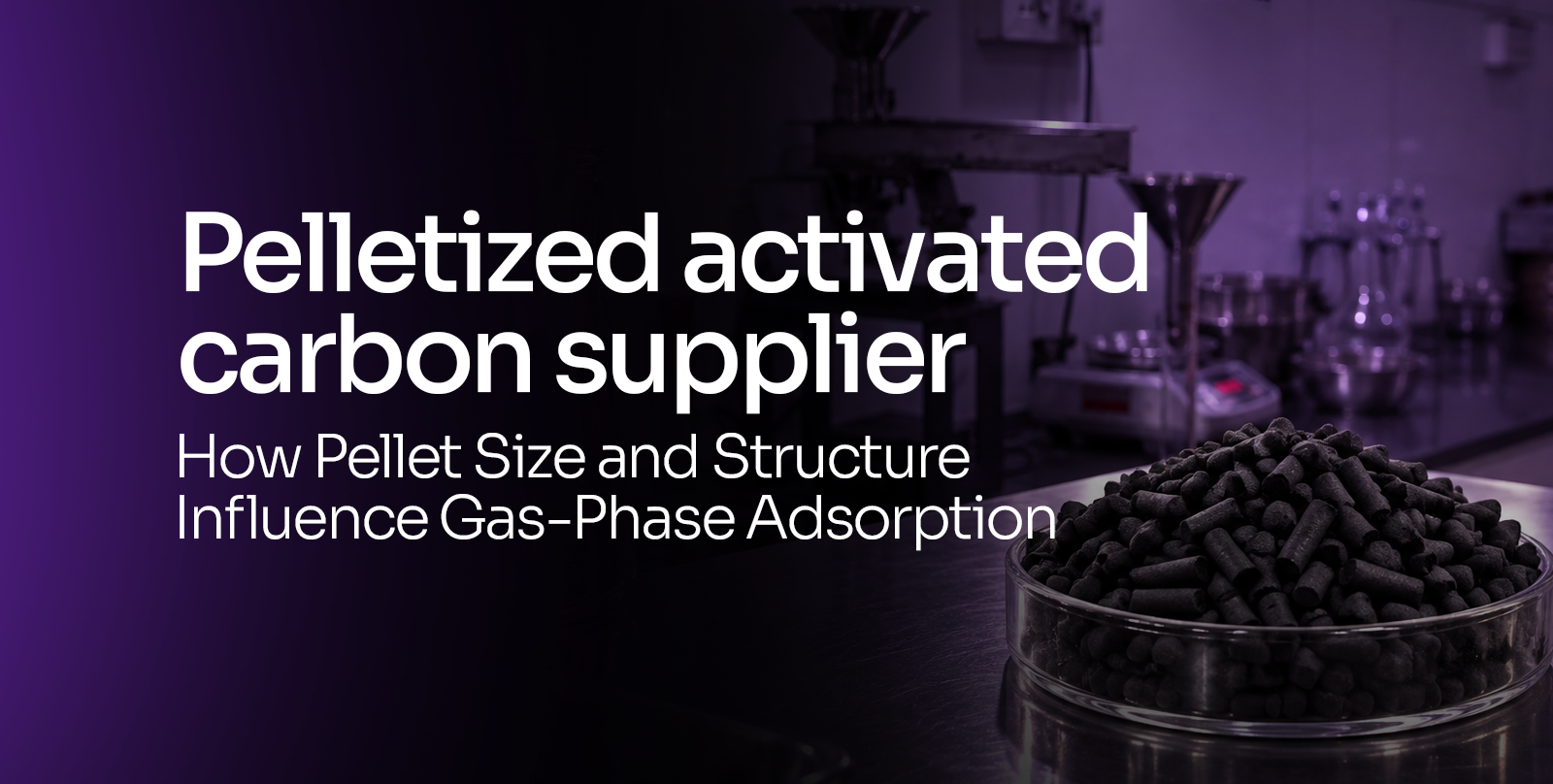
In industrial gas treatment, activated carbon is often used to remove VOCs, odours, hydrocarbons, and other unwanted compounds from process air and gas streams.
For these applications, carbon geometry matters.
Pelletized activated carbon is manufactured into cylindrical or similarly shaped particles with controlled dimensions. Unlike irregular granular carbon, pellets offer a more consistent shape and size throughout the treatment bed.
That physical structure can influence pressure drop, gas distribution, mass transfer, mechanical stability, and ultimately how the carbon bed operates.
For industries evaluating a Pelletized Activated Carbon Supplier, understanding these factors is important when selecting carbon for gas-phase applications.
Why Pelletized Carbon Is Used in Gas Treatment
Gas-phase adsorption systems often operate continuously and may handle significant volumes of air or process gas.
The carbon bed therefore needs to provide sufficient adsorption capacity without creating excessive resistance to gas flow.
Pelletized carbon can offer a more uniform bed structure because the particles have controlled dimensions and geometry. This can help create predictable pathways for gas movement through the bed.
Pellets are also commonly used where pressure drop and mechanical durability are important considerations.
The suitability of a pellet, however, depends on more than its shape. Its pore structure, hardness, diameter, density, and adsorption characteristics all influence how it behaves in an operating system.
Pellet Diameter and Gas Flow
Pellet diameter has a direct relationship with the spaces through which gas travels inside a packed bed.
Smaller pellets generally provide shorter distances for molecules to travel into the carbon. They can support faster mass transfer under suitable conditions.
However, smaller pellets can also increase resistance to gas flow.
Larger pellets can reduce resistance and support lower pressure drop, but the increased diffusion distance may influence adsorption kinetics.
This creates an engineering balance.
The objective is not to choose the smallest or largest pellet available. The objective is to select a pellet dimension that fits the gas flow, equipment configuration, contaminant profile, and operating limitations.
For an industrial carbon bed, this balance can be just as important as the carbon’s adsorption capacity.
Pellet Structure and Internal Diffusion
The external dimensions of a pellet tell only part of the story.
Inside each pellet is a network of pores where adsorption takes place. Gas molecules must move through this structure before reaching available adsorption sites.
The accessibility of these pores depends on the relationship between the pore structure and the molecules being treated.
For example, a carbon designed for a particular gas-phase application may require a pore structure capable of effectively interacting with the target compounds.
Pellet geometry and internal pore structure therefore work together.
A well-designed pellet must provide practical gas flow characteristics while maintaining an internal structure suitable for adsorption.
Mechanical Strength Matters in Continuous Operation
Industrial carbon beds can remain in operation for extended periods.
During loading, unloading, vibration, gas flow, and replacement, pellets experience mechanical stress. Weak pellets can break down and generate fines.
Excessive fines can affect bed resistance and may interfere with downstream equipment.
Pellet strength is therefore an important consideration when selecting carbon for industrial gas treatment.
Hardness and attrition resistance should be evaluated according to the expected handling and operating conditions.
For systems where carbon is frequently replaced or regenerated, mechanical durability can become particularly significant because the carbon may experience repeated physical handling.
Bed Depth and Gas Distribution
Pelletized carbon does not operate as individual particles in isolation.
The pellets form a packed bed, and the way that bed is loaded can influence gas distribution.
Poor distribution can result in sections of the bed receiving more gas than others. This can create uneven carbon utilisation and cause some areas to approach exhaustion faster than the rest of the bed.
Pellet consistency can contribute to more predictable packing characteristics, but equipment design and gas distribution remain important.
The carbon supplier therefore needs to understand the intended application rather than recommending pellets based only on a standard specification.
The Importance of Bulk Density
Bulk density is another physical property relevant to pelletized carbon.
It describes the mass of carbon occupying a given volume, including the spaces between particles within the packed material.
Bulk density can influence how much carbon is loaded into a specific vessel and can be relevant when calculating carbon inventory and handling requirements.
However, a higher bulk density does not automatically indicate better adsorption performance.
It must be considered alongside adsorption capacity, pore structure, pellet dimensions, moisture content, and other relevant properties.
Industrial buyers should therefore avoid using a single physical parameter as the sole basis for carbon selection.
Matching Pellets to the Contaminant
Gas-phase treatment can involve very different contaminants.
VOCs, solvent vapours, hydrocarbons, odour-causing compounds, and other gaseous impurities can behave differently during adsorption.
Their molecular characteristics influence how they interact with activated carbon.
This means the same pellet specification may not provide the same results across every gas stream.
The concentration of the contaminant also matters. A system treating a low-concentration emission stream can have very different requirements from one handling a concentrated process stream.
Temperature and humidity can also influence adsorption behaviour.
A proper carbon selection process therefore starts with understanding the gas stream.
Humidity and Competitive Adsorption
Water vapour can be an important consideration in gas-phase adsorption.
Depending on the carbon and the application, moisture may occupy adsorption sites or influence how certain compounds move through the pore structure.
This can affect the available capacity for target contaminants.
For this reason, gas humidity should be considered when selecting pelletized carbon for industrial applications.
Other compounds within the gas stream can also compete for available adsorption sites. A carbon bed treating a mixed gas stream may therefore behave differently from one treating a single contaminant.
Understanding the complete gas composition helps create a more realistic basis for carbon selection.
What an Industrial Buyer Should Share With a Supplier
When approaching a Pelletized Activated Carbon Supplier, buyers should provide enough information to understand the actual treatment requirement.
Important details may include:
- Gas composition
- Target contaminants
- Contaminant concentration
- Gas flow rate
- Operating temperature
- Relative humidity
- Existing vessel dimensions
- Carbon bed depth
- Allowable pressure drop
- Expected operating cycle
- Carbon replacement requirements
These details allow the carbon specification to be considered in relation to the application.
They also help prevent the selection process from becoming a comparison based only on catalogue values.
CG Carbon’s Approach to Pelletized Carbon
CG Carbon supports industrial customers with activated carbon solutions based on specific treatment requirements.
As a Pelletized Activated Carbon Supplier, CG Carbon can help customers evaluate relevant carbon characteristics for gas-phase applications, including pellet dimensions, physical strength, adsorption properties, and application requirements.
The objective is not to recommend a pellet simply because it has a particular size or specification.
Gas-phase adsorption involves several connected variables. The carbon needs to be considered alongside the contaminant, gas conditions, vessel configuration, and operational requirements.
This application-focused approach allows carbon selection to begin with the treatment challenge rather than a generic product specification.
Selecting the Right Pellet Structure
Pellet selection should consider the complete operating environment.
A suitable pellet needs to balance:
Gas flow
The pellet dimensions should be compatible with the system’s hydraulic requirements.
Mass transfer
The structure should allow target molecules to access relevant adsorption sites effectively.
Mechanical strength
The pellets should withstand handling and expected operating conditions.
Pore structure
The available pore network should be appropriate for the target compounds.
Operating conditions
Temperature, humidity, concentration, and gas composition can influence adsorption behaviour.
For a Pelletized Activated Carbon Supplier, understanding these relationships is essential when supporting industrial applications.
Conclusion
Pelletized activated carbon is more than activated carbon formed into a convenient shape.
Pellet diameter, geometry, pore structure, density, and mechanical strength can all influence how a carbon bed performs in gas-phase treatment.
Smaller pellets may support favourable mass transfer characteristics but can increase resistance to gas flow. Larger pellets can offer different hydraulic advantages while changing diffusion behaviour.
The right choice depends on the application.
For industrial buyers, selecting a Pelletized Activated Carbon Supplier should therefore involve more than comparing particle dimensions or adsorption numbers.
The better approach is to evaluate the pellet as part of the complete gas-treatment system.
At CG Carbon, application requirements remain central to carbon selection, helping customers identify activated carbon characteristics that are appropriate for their specific gas-treatment needs.
Because in gas-phase adsorption, the pellet’s performance depends on how its structure works within the process.
