The Invisible Contaminants Hiding in Industrial Air
Air quality is often judged by what we can see or smell. A clean-looking workspace may seem safe, while an unpleasant odour can immediately raise concerns. However, neither appearance nor smell provides a complete picture of air quality. Many airborne contaminants remain undetectable without appropriate monitoring and analysis.
In industrial environments, these invisible substances can affect workplace conditions, product quality, equipment, and environmental compliance. Managing them requires treatment technologies suited to the specific contaminants involved.
Activated Carbon for Air Purification plays an important role in controlling selected gaseous contaminants, volatile organic compounds (VOCs), and odour-causing substances. Its effectiveness depends on the carbon’s properties, the nature of the contaminants, and the conditions within the treatment system.
Understanding these factors helps industries make informed decisions about air purification instead of relying on a one-size-fits-all solution.
Why Industrial Air Requires More Than Basic Filtration
Industrial air can contain a complex mixture of particles, gases, vapours, and chemical compounds. The composition varies according to the processes performed, the raw materials handled, and the operating environment.
Manufacturing facilities may release solvent vapours. Food-processing operations can generate strong odours. Chemical plants may produce gaseous emissions that require specialised treatment. Oil and gas facilities can encounter contaminants that demand carefully selected purification media.
These pollutants behave differently in air. Particulate matter consists of suspended solid or liquid particles, while gaseous contaminants exist as individual molecules or compounds dispersed in the air stream.
This distinction matters because conventional particulate filters are primarily designed to capture particles. They do not necessarily remove gaseous contaminants effectively.
Industrial air treatment therefore often involves multiple stages. Particulate filters may remove dust and other suspended material, while additional technologies address specific gases and vapours.
Activated carbon is one such technology. It is particularly useful when the treatment objective involves contaminants that can be adsorbed onto the carbon surface.
How Activated Carbon Captures Airborne Contaminants
Activated carbon works through a process called adsorption. Unlike absorption, where a substance enters the bulk of another material, adsorption involves molecules attaching to a surface.
During manufacturing, activation develops an extensive network of pores within the carbon. This structure creates a large internal surface area, providing sites where suitable contaminant molecules can accumulate.
When contaminated air passes through an appropriately designed carbon bed, target molecules can move from the air stream into the carbon’s pore structure. The amount captured depends on the characteristics of the contaminant, the carbon grade, and the operating conditions.
Several factors influence this process.
Pore structure: Different molecules interact differently with carbon pores. The distribution of pore sizes influences which contaminants a particular grade can adsorb effectively.
Contaminant properties: Molecular size, concentration, polarity, and other chemical characteristics affect adsorption behaviour.
Contact time: Air must have sufficient contact with the carbon for adsorption to occur. Excessive flow rates or uneven distribution can reduce treatment performance.
Temperature and humidity: These conditions can influence adsorption capacity. High humidity, in particular, may compete with certain contaminants for adsorption sites, depending on the carbon and application.
Consequently, selecting carbon based only on its total surface area does not guarantee effective air purification. The material must be suitable for the target contaminants and intended operating conditions.
Where Activated Carbon Makes a Difference
Activated Carbon for Air Purification is used across applications where selected gaseous contaminants and unwanted odours need to be controlled.
1. Volatile Organic Compound Removal
VOCs are organic chemicals that can readily enter the air as vapours. They may originate from solvents, coatings, adhesives, cleaning agents, and various industrial processes.
Depending on the compound and treatment conditions, activated carbon can adsorb certain VOCs from exhaust streams or ventilation air. This makes it useful in applications where controlling specific organic vapours is necessary.
However, VOC mixtures vary considerably. A carbon grade suitable for one solvent may not perform equally well against another. Concentration, humidity, temperature, and the presence of competing compounds must also be considered.
2. Industrial Odour Control
Unwanted odours can originate from chemical processing, wastewater operations, food production, and other industrial activities.
Some odour-causing compounds can be captured through adsorption. The appropriate carbon depends on the chemical nature of the substances responsible for the smell.
For example, compounds containing sulphur or nitrogen may require different adsorption characteristics from many ordinary organic vapours. Certain applications may benefit from specially impregnated activated carbon designed to improve the capture of specific contaminants.
Odour control should therefore begin with identifying the likely source rather than selecting a carbon product based on smell intensity alone.
3. Oil and Gas Applications
Oil and gas operations may encounter gaseous contaminants such as mercury, sulphur-containing compounds, and selected hydrocarbons.
These substances present different treatment challenges. Mercury removal, for instance, may require chemically impregnated activated carbon rather than an ordinary carbon grade.
The choice depends on the contaminant’s chemical form, process conditions, required outlet quality, and the overall treatment design.
Activated carbon can support these applications when the selected material is designed for the specific removal objective.
4. Ventilation and Process Air Treatment
Some industrial and commercial facilities use activated carbon filters to address selected gases and odours in ventilation systems or process air streams.
The objective may involve improving incoming air quality, controlling contaminants in recirculated air, or treating air before discharge.
System design is essential. The filter must provide suitable airflow distribution and contact conditions without creating unacceptable pressure drop or maintenance demands.
Activated carbon does not replace particulate filtration, ventilation, or other necessary safety controls. It works as part of a treatment system designed around the contaminants present.
Why Carbon Quality Matters in Air Treatment
The performance of an activated carbon filter depends on more than adsorption capacity alone. Physical durability, particle size, pore distribution, and resistance to breakdown can all influence how the material behaves during operation.
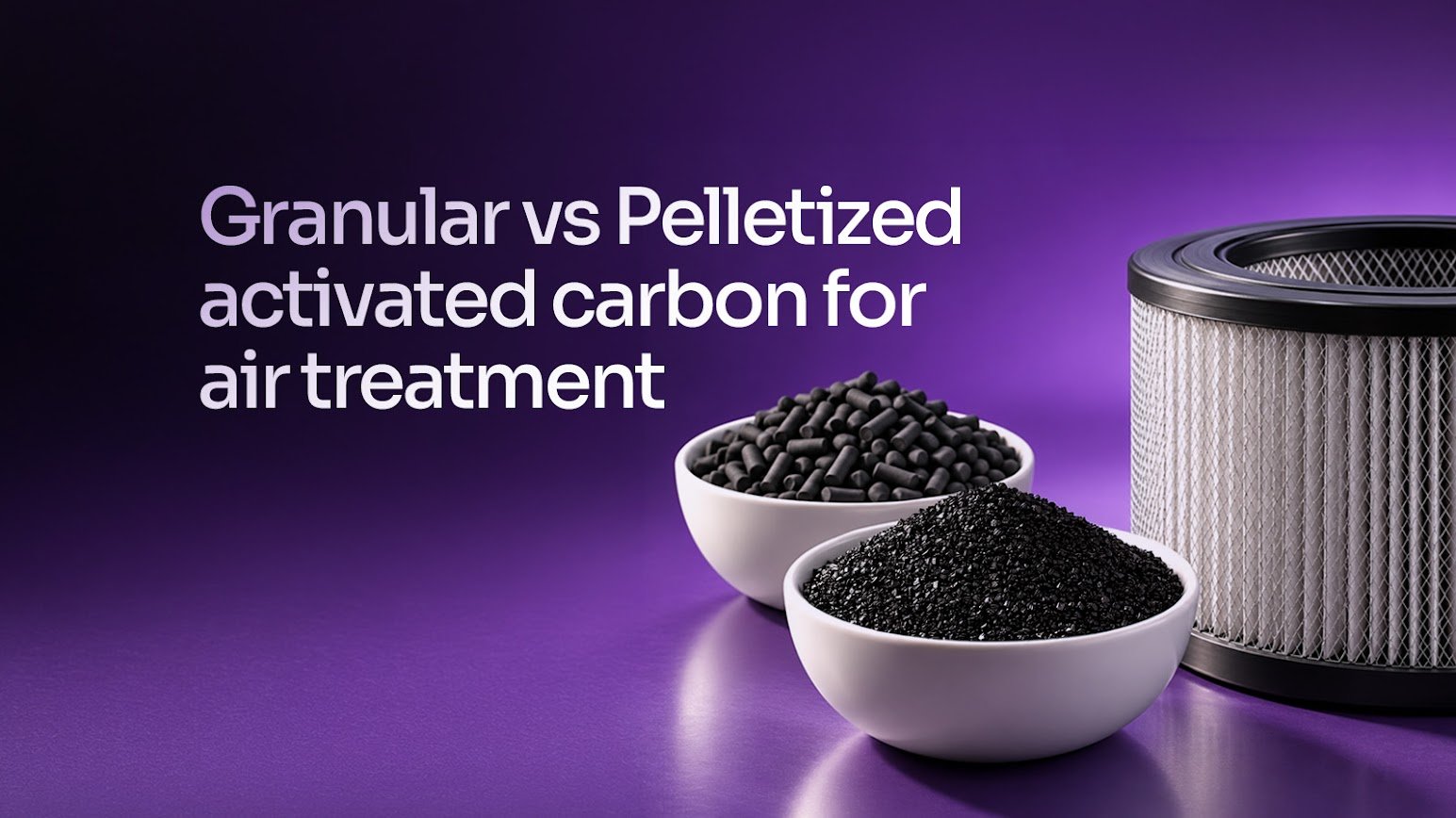
Granular activated carbon used in fixed beds must withstand handling and airflow without producing excessive fines. Physical breakdown can affect pressure drop, downstream filtration requirements, and the practical management of the carbon bed.
Raw material selection and manufacturing processes help determine these properties.
CG Carbon manufactures activated carbon from coconut shell charcoal using steam activation. Coconut shell-based carbon is valued for its hardness and microporous structure, making it relevant to selected purification applications.
For air and gas treatment, the suitability of a particular CG Carbon grade depends on the contaminant and the operating requirements. Not every grade is appropriate for every gaseous pollutant, and specialised applications may require impregnated carbon or another treatment technology.
The important consideration is whether the material’s properties match the intended duty.
How CG Carbon Supports Industrial Air Purification
Selecting activated carbon begins with understanding the customer’s application. The target contaminant, concentration, airflow, temperature, humidity, and required outlet quality all help define the material requirements.
CG Carbon supports industrial buyers by recommending suitable activated carbon based on the intended application and relevant product characteristics.
This application-focused approach helps distinguish between general-purpose carbon and grades intended for more specific purification requirements. It also recognises that successful treatment depends on the interaction between the carbon and the system in which it operates.
For example, a carbon grade intended for selected VOCs should not automatically be assumed suitable for mercury removal. Similarly, a product used for odour control may not meet the requirements of a process involving a chemically different contaminant.
The final selection should be supported by relevant technical specifications and, where necessary, application-specific testing.
Industrial operators must also monitor performance throughout the carbon’s service life. As adsorption sites become occupied, the carbon’s remaining capacity decreases. Depending on the application, breakthrough monitoring, scheduled replacement, or an appropriate regeneration strategy may be necessary.
Carbon selection is therefore one part of a broader air-treatment strategy that includes system design, operating control, and performance monitoring.
Conclusion
Industrial air quality cannot be assessed through appearance or odour alone. Many contaminants require specific treatment approaches, and the effectiveness of any solution depends on understanding what needs to be removed.
Activated Carbon for Air Purification provides a practical method for capturing selected gaseous contaminants and odour-causing compounds when the carbon grade and operating conditions are appropriate.
With its steam-activated, coconut shell-based carbon, CG Carbon supports industrial purification requirements through application-focused product selection. The priority is to identify the contaminant, understand the treatment conditions, and choose a carbon grade suited to the task.
Because effective air purification starts with understanding what is in the air.
Frequently Asked Questions
- What contaminants can activated carbon remove from air?
Activated carbon can adsorb selected volatile organic compounds (VOCs), odour-causing substances, and certain gaseous contaminants. The effectiveness depends on the carbon grade and the properties of the target pollutants.
- How do you choose activated carbon for industrial air purification?
Selection depends on the contaminant type, concentration, airflow, temperature, humidity, and required treatment performance. Some applications may require specially impregnated carbon.
- How does CG Carbon support industrial air purification?
CG Carbon manufactures steam-activated, coconut shell-based activated carbon and recommends suitable grades according to the intended application and relevant technical requirements.