In industrial environments, these invisible substances can affect workplace conditions, product quality, equipment, and environmental compliance. Managing them requires treatment technologies suited to the specific contaminants involved.Activated Carbon for Air Purification plays an important role in controlling selected gaseous contaminants, volatile organic compounds (VOCs), and odour-causing substances. Its effectiveness depends on the carbon’s properties, the nature of the contaminants, and the conditions within the treatment system.Understanding these factors helps industries make informed decisions about air purification instead of relying on a one-size-fits-all solution.
Why Industrial Air Requires More Than Basic Filtration
Industrial air can contain a complex mixture of particles, gases, vapours, and chemical compounds. The composition varies according to the processes performed, the raw materials handled, and the operating environment.Manufacturing facilities may release solvent vapours. Food-processing operations can generate strong odours. Chemical plants may produce gaseous emissions that require specialised treatment. Oil and gas facilities can encounter contaminants that demand carefully selected purification media.These pollutants behave differently in air. Particulate matter consists of suspended solid or liquid particles, while gaseous contaminants exist as individual molecules or compounds dispersed in the air stream.This distinction matters because conventional particulate filters are primarily designed to capture particles. They do not necessarily remove gaseous contaminants effectively.Industrial air treatment therefore often involves multiple stages. Particulate filters may remove dust and other suspended material, while additional technologies address specific gases and vapours.Activated carbon is one such technology. It is particularly useful when the treatment objective involves contaminants that can be adsorbed onto the carbon surface.
How Activated Carbon Captures Airborne Contaminants
Activated carbon works through a process called adsorption. Unlike absorption, where a substance enters the bulk of another material, adsorption involves molecules attaching to a surface.During manufacturing, activation develops an extensive network of pores within the carbon. This structure creates a large internal surface area, providing sites where suitable contaminant molecules can accumulate.When contaminated air passes through an appropriately designed carbon bed, target molecules can move from the air stream into the carbon’s pore structure. The amount captured depends on the characteristics of the contaminant, the carbon grade, and the operating conditions.Several factors influence this process.Pore structure: Different molecules interact differently with carbon pores. The distribution of pore sizes influences which contaminants a particular grade can adsorb effectively.Contaminant properties: Molecular size, concentration, polarity, and other chemical characteristics affect adsorption behaviour.Contact time: Air must have sufficient contact with the carbon for adsorption to occur. Excessive flow rates or uneven distribution can reduce treatment performance.Temperature and humidity: These conditions can influence adsorption capacity. High humidity, in particular, may compete with certain contaminants for adsorption sites, depending on the carbon and application.Consequently, selecting carbon based only on its total surface area does not guarantee effective air purification. The material must be suitable for the target contaminants and intended operating conditions.
Where Activated Carbon Makes a Difference
Activated Carbon for Air Purification is used across applications where selected gaseous contaminants and unwanted odours need to be controlled.
1. Volatile Organic Compound Removal
VOCs are organic chemicals that can readily enter the air as vapours. They may originate from solvents, coatings, adhesives, cleaning agents, and various industrial processes.Depending on the compound and treatment conditions, activated carbon can adsorb certain VOCs from exhaust streams or ventilation air. This makes it useful in applications where controlling specific organic vapours is necessary.However, VOC mixtures vary considerably. A carbon grade suitable for one solvent may not perform equally well against another. Concentration, humidity, temperature, and the presence of competing compounds must also be considered.
2. Industrial Odour Control
Unwanted odours can originate from chemical processing, wastewater operations, food production, and other industrial activities.Some odour-causing compounds can be captured through adsorption. The appropriate carbon depends on the chemical nature of the substances responsible for the smell.For example, compounds containing sulphur or nitrogen may require different adsorption characteristics from many ordinary organic vapours. Certain applications may benefit from specially impregnated activated carbon designed to improve the capture of specific contaminants.Odour control should therefore begin with identifying the likely source rather than selecting a carbon product based on smell intensity alone.
3. Oil and Gas Applications
Oil and gas operations may encounter gaseous contaminants such as mercury, sulphur-containing compounds, and selected hydrocarbons.These substances present different treatment challenges. Mercury removal, for instance, may require chemically impregnated activated carbon rather than an ordinary carbon grade.The choice depends on the contaminant’s chemical form, process conditions, required outlet quality, and the overall treatment design.Activated carbon can support these applications when the selected material is designed for the specific removal objective.
4. Ventilation and Process Air Treatment
Some industrial and commercial facilities use activated carbon filters to address selected gases and odours in ventilation systems or process air streams.The objective may involve improving incoming air quality, controlling contaminants in recirculated air, or treating air before discharge.System design is essential. The filter must provide suitable airflow distribution and contact conditions without creating unacceptable pressure drop or maintenance demands.Activated carbon does not replace particulate filtration, ventilation, or other necessary safety controls. It works as part of a treatment system designed around the contaminants present.
Why Carbon Quality Matters in Air Treatment
The performance of an activated carbon filter depends on more than adsorption capacity alone. Physical durability, particle size, pore distribution, and resistance to breakdown can all influence how the material behaves during operation.Granular activated carbon used in fixed beds must withstand handling and airflow without producing excessive fines. Physical breakdown can affect pressure drop, downstream filtration requirements, and the practical management of the carbon bed.Raw material selection and manufacturing processes help determine these properties.CG Carbon manufactures activated carbon from coconut shell charcoal using steam activation. Coconut shell-based carbon is valued for its hardness and microporous structure, making it relevant to selected purification applications.For air and gas treatment, the suitability of a particular CG Carbon grade depends on the contaminant and the operating requirements. Not every grade is appropriate for every gaseous pollutant, and specialised applications may require impregnated carbon or another treatment technology.The important consideration is whether the material’s properties match the intended duty.
How CG Carbon Supports Industrial Air Purification
Selecting activated carbon begins with understanding the customer’s application. The target contaminant, concentration, airflow, temperature, humidity, and required outlet quality all help define the material requirements.CG Carbon supports industrial buyers by recommending suitable activated carbon based on the intended application and relevant product characteristics.This application-focused approach helps distinguish between general-purpose carbon and grades intended for more specific purification requirements. It also recognises that successful treatment depends on the interaction between the carbon and the system in which it operates.For example, a carbon grade intended for selected VOCs should not automatically be assumed suitable for mercury removal. Similarly, a product used for odour control may not meet the requirements of a process involving a chemically different contaminant.The final selection should be supported by relevant technical specifications and, where necessary, application-specific testing.Industrial operators must also monitor performance throughout the carbon’s service life. As adsorption sites become occupied, the carbon’s remaining capacity decreases. Depending on the application, breakthrough monitoring, scheduled replacement, or an appropriate regeneration strategy may be necessary.Carbon selection is therefore one part of a broader air-treatment strategy that includes system design, operating control, and performance monitoring.
Conclusion
Industrial air quality cannot be assessed through appearance or odour alone. Many contaminants require specific treatment approaches, and the effectiveness of any solution depends on understanding what needs to be removed.Activated Carbon for Air Purification provides a practical method for capturing selected gaseous contaminants and odour-causing compounds when the carbon grade and operating conditions are appropriate.With its steam-activated, coconut shell-based carbon, CG Carbon supports industrial purification requirements through application-focused product selection. The priority is to identify the contaminant, understand the treatment conditions, and choose a carbon grade suited to the task.Because effective air purification starts with understanding what is in the air.
Frequently Asked Questions
What contaminants can activated carbon remove from air?
Activated carbon can adsorb selected volatile organic compounds (VOCs), odour-causing substances, and certain gaseous contaminants. The effectiveness depends on the carbon grade and the properties of the target pollutants.
How do you choose activated carbon for industrial air purification?
Selection depends on the contaminant type, concentration, airflow, temperature, humidity, and required treatment performance. Some applications may require specially impregnated carbon.
How does CG Carbon support industrial air purification?
CG Carbon manufactures steam-activated, coconut shell-based activated carbon and recommends suitable grades according to the intended application and relevant technical requirements.
Activated carbon is commonly used in industrial air filtration systems due to its porous structure and ability to adsorb certain gaseous contaminants. Activated carbon for industrial air purification offers a practical solution for industries seeking to control pollutants in exhaust air and process gas streams. However, the effectiveness of this method largely depends on the type of carbon used, the nature of the contaminants, and the operating conditions.How does Activated Carbon work?Activated carbon is a highly porous material with an extensive internal surface area that enables it to capture certain gaseous contaminants through a process called adsorption. When contaminated air passes through an activated carbon bed, suitable gas molecules attach to the carbon’s surface and remain trapped within its pore structure. Over time, the carbon’s adsorption capacity decreases as the available sites become occupied. Depending on the application, the carbon must then be replaced or regenerated to maintain treatment efficiency. Activated carbon for industrial air purification helps industries control selected volatile organic compounds (VOCs), chemical vapours, and unpleasant odours in exhaust air and process gas streams.The effectiveness of activated carbon depends on several factors, including the type and concentration of contaminants, temperature, humidity, airflow rate, and contact time. Choosing the right type of activated carbon for each application is crucial for efficient contaminant removal and reliable performance.Industrial Applications of Activated Carbon for Air Purification
Chemical and Petrochemical Process Industry
The chemicals and petrochemical process industries could generate solvents, hydrocarbons, and VOCs in their processing systems. This would be managed through the use of activated carbon adsorption systems that adsorb appropriate vapours from the exhaust gases for vapour control.
Paints, Coatings, and Printing Process
In this kind of industrial process, there could be emissions of solvent-based pollutants that cause air pollution and odours. Activated carbon adsorption systems can be used to remove appropriate organic vapours.
Wastewater Treatment Plants
Wastewater treatment plants might emit odours that arise from some chemicals in the wastewater through the processes involved. Some selected types of activated carbon can be used to control such gaseous compounds.
Oil and Gas
Processes involving oil and gas may lead to emissions of hydrocarbon gases through storage and refining processes. Activated carbon may be used in gas treatment systems which collect the appropriate organic compounds.
Food and Beverage Processing
Food and beverage production processes such as cooking, roasting and fermentation may emit odorous gases. These may be controlled using activated carbon in gas exhaust treatment systems.Factors to Consider When Choosing Activated CarbonSelecting activated carbon for industrial air purification involves assessing the technical requirements of the particular process.These factors are:
Pore structure: It affects adsorption of different contaminants.
Particle size: This affects the flow of air and pressure, as well as contact between the gas molecules and the carbon particles.
Strength: It helps to preserve the bed of carbon throughout the process.
Temperature and humidity: They affect adsorption behaviour and treatment efficiency.
Concentration of contaminant: It determines the adsorption load.
Pelletized activated carbon is normally used in gas-phase operations owing to the consistent shape that allows the flow of air at low pressure drop. Granular and impregnated activated carbons are applicable in other applications depending on the target contaminants.Why Choose CG Carbon?CG Carbon helps businesses explore suitable activated carbon products for applications involving activated carbon for industrial air purification, depending on their specific process requirementsCarbon selection should be based on its application, the contaminants involved, and what is expected from the purification equipment. In the case of gases, it is necessary to ensure that the suitable carbon grade has the right adsorption properties.Businesses have the freedom to investigate the products that are available and consult with the supplier regarding their needs. The products that CG Carbon offers include pelletized activated carbon, which might be considered by various companies as a solution for gas and vapour treatment processes. ConclusionIndustrial air purification is one of the most important elements in ensuring proper working conditions, as well as controlling emissions resulting from the processes of production and manufacturing. Activated carbon is a solution to reduce many types of pollutants, vapours, and unwanted odours with the use of adsorption technology when applicable. It allows its application in various industries including chemical and petrochemical, printing, water treatment, the oil and gas industry, and food processing. Nevertheless, obtaining good results using this method demands much more than placing the carbon filter into the system. Industries have to be aware of the source of emissions, choose the correct grade of carbon, consider humidity and temperature, and have sufficient contact time and flow control.Inspection and timely replacement of carbon are also important in keeping up performance because of exhaustion of adsorptive ability. Through working with an experienced supplier and analysing the needs of each particular application, companies can make better choices regarding their air treatment systems. By selecting a proper product and designing the system properly, activated carbon used for industrial air purification can be helpful in dealing with odours and controlling chosen air contaminants.
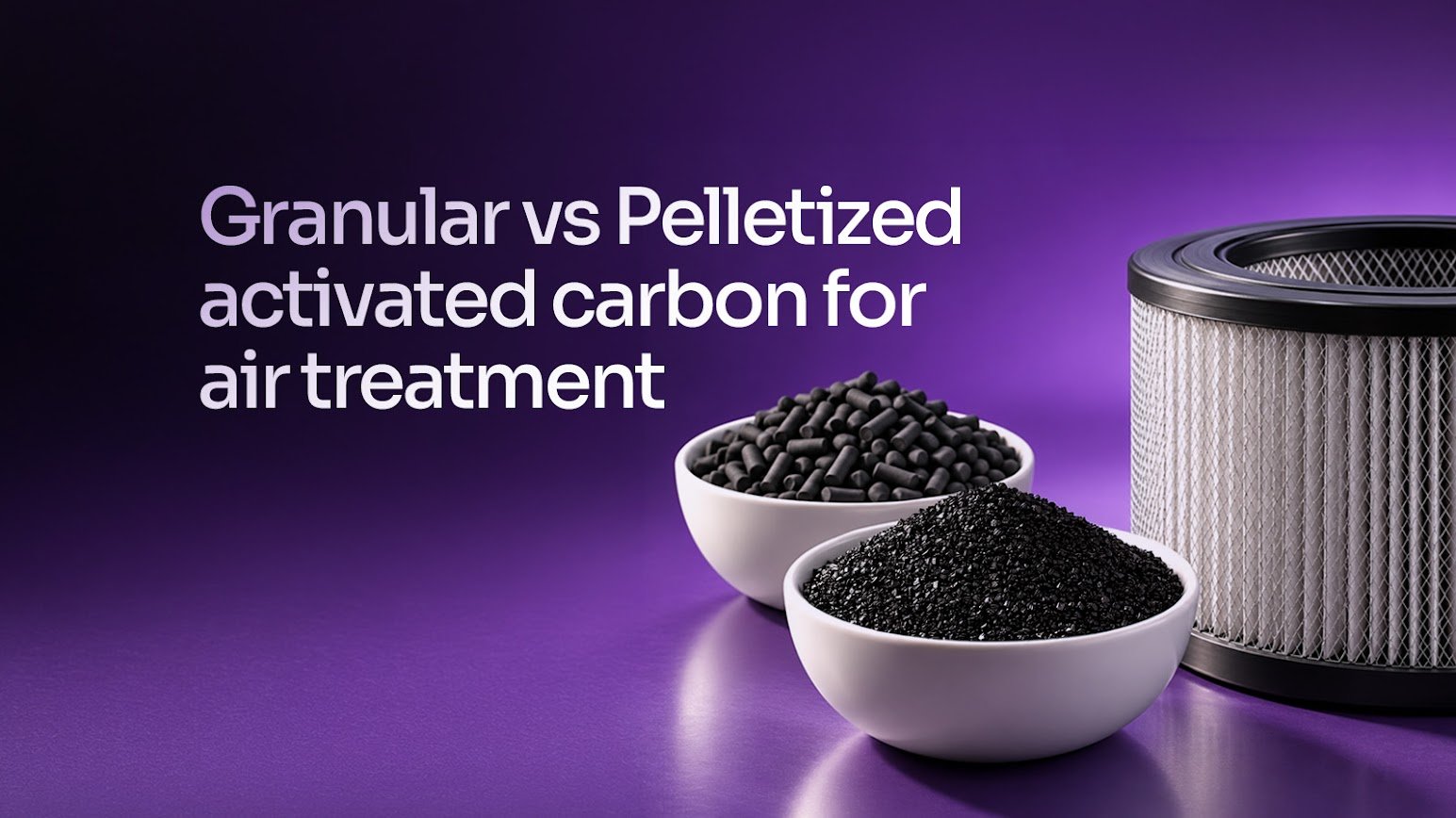
Choosing between granular and pelletized carbon depends on particle shape, airflow, pressure drop, dust generation, and system design. Understanding Granular vs Pelletized Activated Carbon for Air Treatment helps industries identify a product that matches their contaminants, equipment, and operating conditions.
What Is Activated Carbon for Air Treatment?
Activated carbon is a porous material with an extensive internal surface area. During air treatment, suitable gas molecules attach to surfaces within its pores through adsorption. Unlike absorption, which involves a substance entering the bulk of another material, adsorption occurs primarily at surfaces.Activated carbon is used in industrial ventilation, odour control, solvent recovery, and selected gas purification applications. Its performance depends on pore structure, contaminant characteristics and concentration, temperature, humidity, and contact time.The physical form of the carbon also matters because it influences particle packing and the way air passes through the adsorption bed.
What Is Granular Activated Carbon?
Granular activated carbon (GAC) consists of irregularly shaped particles available in different size ranges. It is commonly used in fixed-bed filtration systems for treating liquids and gases.In air treatment, granular carbon is packed into a filter housing or adsorption vessel. As contaminated air passes through the bed, suitable gaseous contaminants interact with the carbon’s porous surface and may be retained through adsorption.
Key Benefits of Granular Activated Carbon
Flexible filter design
Granular carbon can be used in various filter configurations designed for granular media. The appropriate particle size and bed depth depend on equipment dimensions, airflow requirements, and treatment objectives.
Application-specific selection
Different granular grades offer different physical and adsorption characteristics. This allows industries to evaluate products according to the target contaminants and operating conditions.
Compatibility with existing systems
Granular carbon may be preferred when an existing vessel or filter is specifically designed for granular media. Retaining a compatible configuration can help avoid unnecessary equipment modifications.However, irregular particle shapes and variations in particle size can influence bed packing, airflow distribution, and pressure drop. These factors should be considered during system design.
What Is Pelletized Activated Carbon?
Pelletized activated carbon is manufactured into cylindrical particles with relatively uniform diameters and lengths. It is commonly considered for gas-phase applications where particle dimensions, bed structure, and mechanical properties are important.Pelletized activated carbon for air treatment can be suitable for controlling selected VOCs and odour-causing compounds when its adsorption characteristics match the gas stream. Its performance depends on the carbon grade, operating conditions, and compatibility with the treatment equipment.
Key Benefits of Pelletized Activated Carbon
More uniform particle geometry
The consistent dimensions of pellets can help engineers characterise bed packing and design airflow paths in systems intended for pelletized media.
Suitable airflow characteristics
Pelletized carbon may provide suitable pressure-drop characteristics in a properly designed system. Actual performance depends on pellet dimensions, bed depth, gas velocity, and packing conditions.
Mechanical strength considerations
Grades with suitable hardness and attrition resistance can help limit particle breakdown during handling and operation. Relevant product specifications should be reviewed to assess this characteristic.
Compatibility with industrial gas treatment
Pelletized carbon may be suitable for industrial gas treatment applications involving VOCs and odours when the selected grade meets the process requirements. Evaluating pelletized activated carbon for air treatment should include adsorption properties, particle dimensions, and the operating limits of the system.
Granular vs Pelletized Activated Carbon: Key Differences
The main difference between granular and pelletized activated carbon lies in their particle shape and how they behave within an adsorption system. Granular activated carbon consists of irregularly shaped particles, while pelletized activated carbon is manufactured into cylindrical forms with relatively uniform dimensions. These physical differences influence bed packing, airflow, pressure drop, and dust generation.Granular carbon may be preferred for existing filtration systems designed for granular media, particularly when a suitable particle size and adsorption capacity meet the application requirements. However, variations in particle size and shape can affect how the carbon packs within the bed and how air moves through it. Pelletized carbon, on the other hand, offers more uniform particle geometry, which can help engineers design and evaluate packed beds with defined dimensions. Its prepressure-drop characteristics depend on pellet diameter and length, bed depth, airflow velocity, and packing conditions.Dust generation is another consideration when selecting between the two forms. Both granular and pelletized carbon can produce fines during handling and operation, depending on their mechanical strength, attrition resistance, and handling conditions. The appropriate choice therefore depends on the required adsorption performance, equipment design, airflow requirements, and product specifications rather than particle shape alone.Neither form is universally better. Smaller particles can offer shorter diffusion paths but may increase flow resistance, while larger particles can reduce resistance under suitable conditions but may affect mass-transfer performance. The final selection should consider the complete treatment system.
How to Choose the Right Activated Carbon for Air Treatment
Once the preferred physical form has been identified, several factors help determine the suitable carbon grade.
1. Identify the Target Contaminants
VOCs, hydrocarbons, and odour-causing compounds have different adsorption characteristics. Their molecular properties, concentrations, and interactions with other gas components influence how effectively they can be captured.Identifying the gas composition helps determine which carbon grades warrant further evaluation.
2. Evaluate Operating Conditions
Temperature, relative humidity, gas flow rate, and contaminant concentration all affect adsorption performance. High humidity may reduce adsorption for certain compounds, while higher temperatures can reduce the capacity of many physically adsorbing carbons.These conditions should be assessed alongside the product’s technical specifications.
3. Check System Compatibility
The carbon must suit the dimensions and operating limits of the treatment equipment. Bed depth, airflow velocity, particle size, pressure-drop limits, and media-retention arrangements should be reviewed together.For applications considering pelletized activated carbon for air treatment, the pellet dimensions must be compatible with the vessel design and required airflow conditions.
4. Review Product Specifications and Maintenance Needs
Relevant specifications may include particle dimensions, adsorption-related properties, moisture content, hardness, and attrition resistance, where available for the selected grade.Dust generation, handling requirements, contaminant loading, and replacement intervals should also be considered. Actual service life depends on the application and operating conditions rather than particle shape alone.
How CG Carbon Can Support Product Selection
Selecting activated carbon for air treatment requires a clear understanding of the contaminants, operating conditions, and equipment design. Comparing particle shapes is only one part of the process.CG Carbon is an established Indian manufacturer of coconut shell-based activated carbon, recognised for its diverse product portfolio and focus on industrial purification solutions. Its range includes granular and pelletized activated carbon, along with specialised impregnated carbons. With research and development capabilities, laboratory facilities, and a commitment to product quality, CG Carbon brings technical expertise to the evolving needs of industrial air and gas treatment.For industrial buyers, product evaluation should begin with the target gas composition, operating temperature and humidity, airflow rate, and the design of the existing adsorption bed. These details help establish which product specifications need to be assessed. CG Carbon’s range of product grades and published technical specifications provides a starting point for evaluating suitable options against these requirements.When evaluating CG Carbon’s available grades, buyers should review the applicable technical datasheets and confirm relevant parameters such as particle dimensions, adsorption properties, and mechanical strength where specified. Application-specific testing may also be necessary when performance requirements are demanding. By combining its product range, manufacturing expertise, and technical capabilities, CG Carbon aims to help industries identify activated carbon solutions suited to their purification needs.
Conclusion
Granular and pelletized activated carbon both play important roles in industrial air treatment. Granular activated carbon remains a widely used choice because it is compatible with many established fixed-bed filtration systems and is available in different particle sizes to suit various application requirements. Its versatility and suitability for conventional filtration setups make it a practical option across many industrial applications.Pelletized carbon also offers advantages for systems designed around cylindrical media, particularly where uniform particle dimensions and specific airflow characteristics are important. The suitability of either form depends on the target contaminants, adsorption performance, airflow requirements, pressure drop, and equipment design.Selecting the right activated carbon grade requires careful consideration of these factors alongside verified product specifications. By understanding the demands of the application, industries can identify a suitable solution, whether granular media or pelletized activated carbon for air treatment, to support effective and reliable purification.
This is where Activated Carbon for Water Treatment becomes an important part of industrial purification. Through adsorption, activated carbon can capture selected contaminants that conventional treatment stages may not adequately remove. However, its effectiveness depends on more than simply adding carbon to a treatment system. Understanding the water chemistry, target contaminants, and operating requirements is essential to achieving the intended result.
What Happens Beyond Visible Water Quality?
Industrial water may contain dissolved organic compounds, residual chlorine, taste and odour-causing substances, and other contaminants. Their presence depends on the source water, industrial activity, and upstream treatment processes.Some contaminants affect the water’s suitability for manufacturing. Others may interfere with downstream processes or compromise the quality requirements of the final product.Conventional treatment methods address specific challenges, such as suspended solids, microbial risks, or dissolved substances. However, no single treatment method addresses every contaminant.Activated carbon offers a different mechanism. Its porous structure provides an extensive internal surface where suitable molecules can attach. This process, known as adsorption, allows certain contaminants to be captured as water passes through the carbon bed.The key is understanding which substances the carbon needs to remove. Without that distinction, selecting a carbon product based solely on general performance claims can lead to unsuitable treatment decisions.
Why Carbon Selection Matters More Than You Think
Not all activated carbon performs identically. Raw material, pore structure, particle size, hardness, and surface characteristics influence how a particular grade behaves in a given application.Activated Carbon for Water Treatment must therefore be selected according to the contaminants involved and the conditions under which the system operates.For example, a water stream containing organic compounds presents different adsorption requirements from one that primarily needs dechlorination. Similarly, the presence of competing organic substances can influence how effectively target contaminants occupy available adsorption sites.Water chemistry also matters. Changes in pH, temperature, and contaminant concentration may affect adsorption performance, depending on the substances involved.This is why a grade suitable for one industrial facility may not deliver the same results in another. The objective is not to find a universal carbon, but to identify a material suited to the intended purification requirement.
The Role of CG Carbon in Industrial Water Treatment
CG Carbon manufactures activated carbon from coconut shell charcoal using steam activation. This production approach develops the porous structure required for adsorption without relying on chemical activation.For water-treatment applications, the suitability of a particular carbon grade depends on the contaminants to be addressed and the treatment system’s requirements.Coconut shell-based activated carbon is valued for its hardness and microporous structure. These properties can be relevant in applications involving selected dissolved organic contaminants and other substances that the carbon grade is designed to adsorb.CG Carbon’s role is to recommend suitable activated carbon based on the intended application and relevant technical requirements. This helps industrial buyers make informed product-selection decisions rather than relying on broad claims about carbon performance.However, the carbon itself is only one part of the treatment process. Effective application also depends on appropriate system design, operating conditions, and monitoring. Product selection should complement these factors, not replace them.
What Determines Treatment Performance Over Time?
Even a suitable carbon grade needs to operate under appropriate conditions. Several factors influence its performance throughout service.Contaminant loading: Higher concentrations or larger volumes of target substances can increase the rate at which adsorption capacity is consumed.Competing substances: Other compounds in the water may occupy adsorption sites, reducing the capacity available for specific contaminants.Contact conditions: The interaction between water and carbon depends on factors such as flow distribution, particle size, and contact time. Poor distribution can limit the effective use of the carbon bed.Pre-treatment: Removing suspended solids and addressing other relevant water-quality issues can help protect the carbon bed and support consistent operation.Monitoring and replacement: Changes in outlet-water quality can indicate that treatment performance needs attention. Monitoring should follow the requirements of the application and the contaminants being controlled.Importantly, activated carbon is not a universal solution for every water-quality problem. Dissolved salts, many inorganic substances, and microorganisms may require other treatment technologies or additional treatment stages. The complete process must match the water-quality objective.
Making Better Decisions About Water Purification
Choosing Activated Carbon for Water Treatment starts with a clear understanding of the problem. Industries should identify their target contaminants, assess incoming water quality, establish the required outlet-water standards, and evaluate how the carbon will fit into the existing treatment process.These steps help narrow the selection to grades suited to the actual application. They also create a more practical basis for evaluating performance, planning maintenance, and managing carbon consumption.For industrial facilities, the goal is not simply to install a filtration material. It is to maintain the water quality required for consistent operations.
Conclusion
Water that looks clean may still require carefully targeted purification. Effective treatment begins with understanding the contaminants present and selecting technologies suited to their removal.Activated Carbon for Water Treatment can play a valuable role in this process when the carbon grade matches the application and operating conditions are properly managed.With its steam-activated, coconut shell-based carbon, CG Carbon supports industrial water-treatment requirements through application-focused product selection. The right starting point is always the same: understand the water, identify the treatment objective, and choose the carbon accordingly.
Frequently Asked Questions
What contaminants can activated carbon remove from water?
Activated carbon can adsorb selected dissolved organic compounds, chlorine, and substances responsible for unpleasant taste and odour. Its effectiveness depends on the carbon grade and water chemistry.
How do you choose the right activated carbon for water treatment?
Selection depends on the target contaminants, water quality, particle size, adsorption properties, and operating conditions. The chosen grade should match the specific treatment requirements.
How does CG Carbon support industrial water treatment?
CG Carbon manufactures steam-activated, coconut shell-based activated carbon and recommends suitable grades based on the intended application and relevant technical requirements.