Purchasing activated carbon in bulk requires more planning than purchasing material for a trial or small-volume application.Industrial users may depend on recurring supplies to maintain continuous treatment, purification or recovery processes. Product variation or supply disruption can therefore affect operations.When selecting a bulk activated carbon supplier, buyers should assess whether the manufacturer can consistently produce the required specification and volume.
Key Risks in Bulk Procurement
Batch Variation
Activated carbon properties may vary when raw materials or manufacturing conditions change. Depending on the application, variation in particle size, hardness, ash, moisture or adsorption characteristics can affect process performance. For repeat orders, agreed specifications and appropriate batch testing are therefore important.
Supply Interruptions
Customers operating with limited inventory can be affected by production or shipment delays.
Production lead time
Order frequency
Expected consumption
Packaging
Transport time
Safety stock requirements
Incorrect Product Selection
Activated carbon is not a one-size-fits-all product. A grade used for water treatment may not be suitable for gas purification, gold recovery or another specialised application. Selection should therefore be based on the intended process and required performance.
Evaluating Price in Context
Purchase price should be considered together with product suitability and operating performance. A lower-priced product may not necessarily provide a lower overall operating cost if consumption, physical loss or replacement frequency is higher.
What Industrial Buyers Should Evaluate
Technical Specification
Relevant parameters may include iodine value, absorption capacity, hardness, moisture, ash, particle-size distribution, bulk density and application-specific adsorption parameters. Only the parameters relevant to the intended application need to be prioritised.
Manufacturing Capability
The supplier should have sufficient production capability to support both current and anticipated requirements.
Quality Control
Defined testing procedures should be used to verify compliance with agreed specifications.
Application Knowledge
A technically informed supplier should be able to discuss the customer’s process conditions before recommending a grade.
Supply Planning
For recurring bulk purchases, production and shipment schedules should be aligned with expected consumption.
Customised Product Requirements
Certain industrial applications may require specifications different from standard commercial grades.
Particle size
Adsorption characteristics
Hardness
Moisture
Ash
Bulk density
Packaging
Other application-specific parameters
The objective of customisation should be to match the carbon to the process requirement.
Applications for Bulk Activated Carbon
Bulk activated carbon is used across several industries, including:
Water and wastewater treatment
Air and gas purification
Gold recovery
Food and beverage processing
Pharmaceutical manufacturing
Chemical processing
Automotive filtration and emission-control applications
Each application requires different technical characteristics and should be evaluated separately.
CG Carbon’s Approach to Bulk Supply
CG Carbon manufactures coconut shell activated carbon for different industrial applications.Its production and supply activities include raw-material selection, activation, grading, laboratory testing, product development, packaging and domestic or international supply coordination.Different product grades can be discussed based on the customer’s application and required specifications.
Conclusion
Choosing a bulk activated carbon supplier should not be based solely on price or the performance of a single sample.Industrial buyers should evaluate whether the manufacturer can consistently supply the required product specification and quantity while supporting appropriate quality control and supply planning.Clear specifications and realistic procurement planning help establish a more dependable basis for recurring activated carbon supply.
Frequently Asked Questions
1. What should buyers check before selecting a bulk activated carbon supplier?
Variation in activated carbon characteristics can affect process performance. Maintaining agreed specifications helps provide more predictable operating conditions.
3. Which quality parameters should be checked?
Depending on the application, parameters may include iodine value, CTC activity, hardness, moisture, ash, particle size, bulk density and application-specific adsorption performance.
4. Can activated carbon specifications be customised?
Different grades or specifications may be developed or selected according to the intended application and manufacturing capability.
5. Why is coconut shell activated carbon used in industrial applications?
Coconut shell activated carbon has a well-developed pore structure, good mechanical strength and relatively low ash content, making it suitable for a range of adsorption and recovery applications.
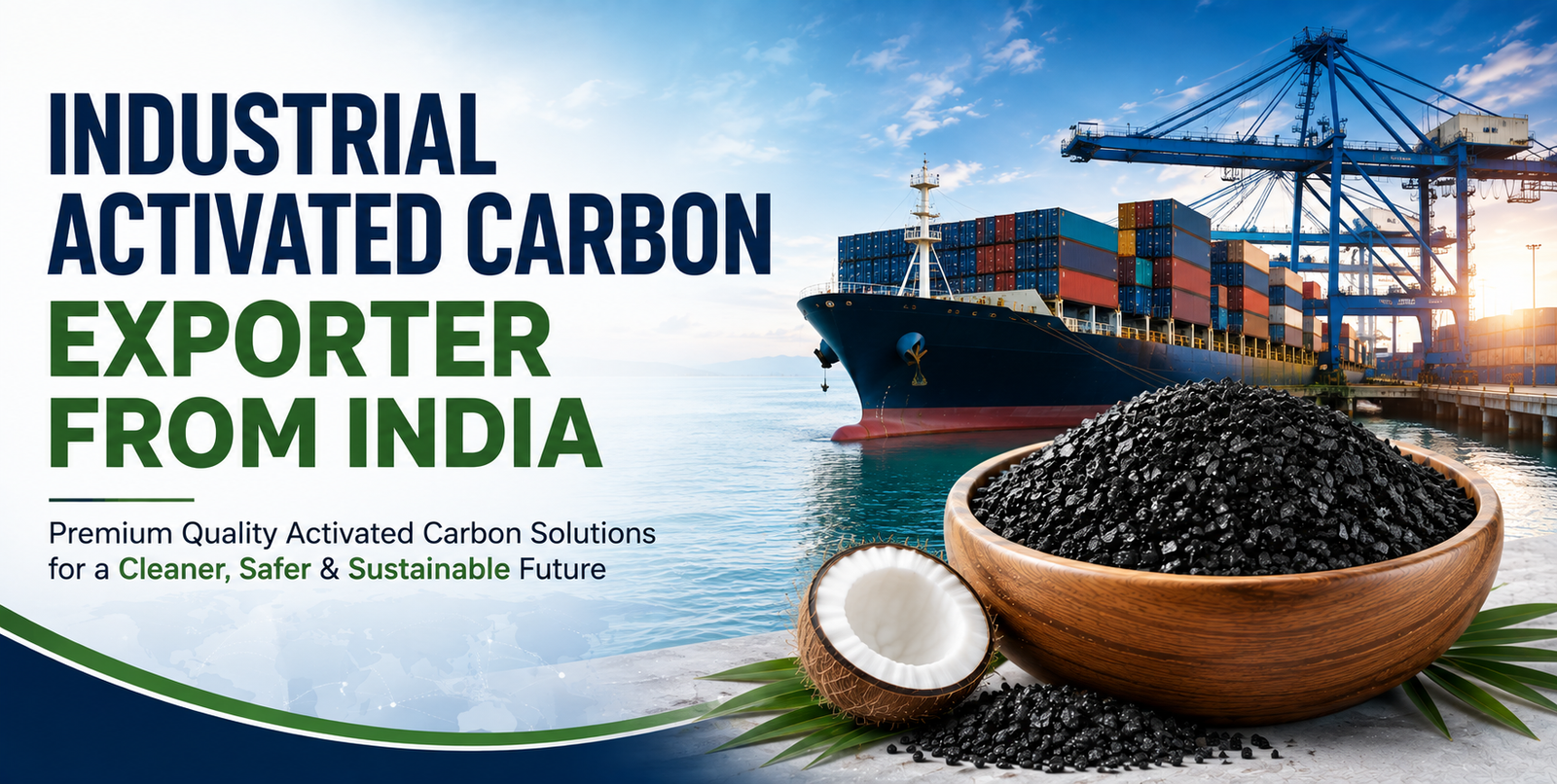
Activated carbon is used in water treatment, air and gas purification, gold recovery, food and beverage processing, pharmaceuticals, and other industrial processes.For international buyers, activated carbon procurement involves more than comparing prices. Product specifications, manufacturing consistency, production capability, documentation, and shipment planning can all influence supply performance.India is an established manufacturing and export base for coconut shell activated carbon. CG Carbon manufactures and exports coconut shell activated carbon from India for a wide range of industrial applications.This article highlights the key factors buyers should consider when evaluating an Industrial Activated Carbon Exporter from India.
Activated Carbon as an Industrial Process Material
Activated carbon becomes part of the customer’s treatment, purification, or recovery process. Its suitability should therefore be evaluated according to the intended application rather than only by a general product description.
Technical specifications
Application requirements
Batch consistency
Required volumes
Packaging
Quality documentation
Shipment schedules
Raw Material and Manufacturing
For coconut shell activated carbon, production begins with coconut shell charcoal. Characteristics such as density, hardness, and consistency of the charcoal can influence the properties developed during activation.The manufacturing process typically includes activation, sizing, grading, testing, and packaging. Control across these stages helps manufacturers maintain defined product specifications.
Important Product Parameters
Depending on the application, buyers may evaluate:
Iodine value
Adsorption capacity
Hardness
Moisture
Ash content
Particle-size distribution
Bulk density
Application-specific adsorption performance
Marketing terms such as “premium” or “high-performance” should not replace measurable technical specifications.
Industrial Applications
Water and Wastewater Treatment
Activated carbon can help reduce chlorine, taste and odour compounds, and selected dissolved organic contaminants.
Air and Gas Purification
Activated carbon may be used for VOC control, odour reduction, and selected gas-treatment applications.
Food and Beverage Processing
Activated carbon can support purification and decolourisation processes where appropriate product specifications are required.
Pharmaceutical Processing
Activated carbon may be used in selected purification applications according to process and purity requirements.
Gold Recovery
Coconut shell activated carbon is widely used in Carbon-in-Pulp (CIP), Carbon-in-Leach (CIL), and Carbon-in-Column (CIC) circuits. Important characteristics include adsorption performance, hardness, attrition resistance, and particle-size distribution.
Oil, Gas and Automotive Applications
Activated carbon is also used in applications including gas purification, hydrocarbon vapour control, selected mercury-removal systems, EVAP systems, and cabin-air filtration. The appropriate grade depends on the specific application.
Five Questions Global Buyers Should Ask
1. Why do international buyers source activated carbon from India?
India has established coconut shell activated carbon manufacturing capabilities and access to international export infrastructure.
2. Which specifications should buyers compare?
Relevant parameters may include iodine value, CTC activity, hardness, ash, moisture, particle size, bulk density, and application-specific performance.
3. Can product specifications be customised?
Different grades or specifications can be selected or developed according to application requirements and manufacturing capability.
4. What should be checked before placing a bulk export order?
Buyers should review specifications, manufacturing capability, quality-control procedures, packaging, documentation, and shipment arrangements.
5. Which industries does CG Carbon serve?
CG Carbon supplies activated carbon for water treatment, air and gas purification, food and beverage, pharmaceuticals, gold recovery, oil and gas, automotive, tobacco, and specialised filtration applications.
CG Carbon’s Export Approach
CG Carbon manufactures coconut shell activated carbon for applications including:
Water and wastewater treatment
Air and gas purification
Food and beverage processing
Pharmaceuticals
Gold recovery
Oil and gas
Automotive
Tobacco
PPE and specialised filtration
For international orders, the company coordinates production, testing, packaging, export documentation, and shipment planning. Product grades can be discussed according to the technical requirements of the customer’s application.
Conclusion
Choosing an Industrial Activated Carbon Exporter from India requires consideration of both the product and the manufacturer’s ability to support repeat international supply.Buyers should evaluate measurable specifications, manufacturing controls, quality testing, production capability, and export coordination.Clear technical requirements and structured supply planning provide a stronger basis for long-term international procurement.
Frequently Asked Questions
1. Why do international buyers source activated carbon from India?
India has established coconut shell activated carbon manufacturing capabilities and access to international export infrastructure.
2. Which specifications should buyers compare?
Relevant parameters may include iodine value, CTC activity, hardness, ash, moisture, particle size, bulk density, and application-specific performance.
3. Can product specifications be customised?
Different grades or specifications can be selected or developed according to application requirements and manufacturing capability.
4. What should be checked before placing a bulk export order?
Buyers should review specifications, manufacturing capability, quality-control procedures, packaging, documentation, and shipment arrangements.
5. Which industries does CG Carbon serve?
CG Carbon supplies activated carbon for water treatment, air and gas purification, food and beverage, pharmaceuticals, gold recovery, oil and gas, automotive, tobacco, and specialised filtration applications.
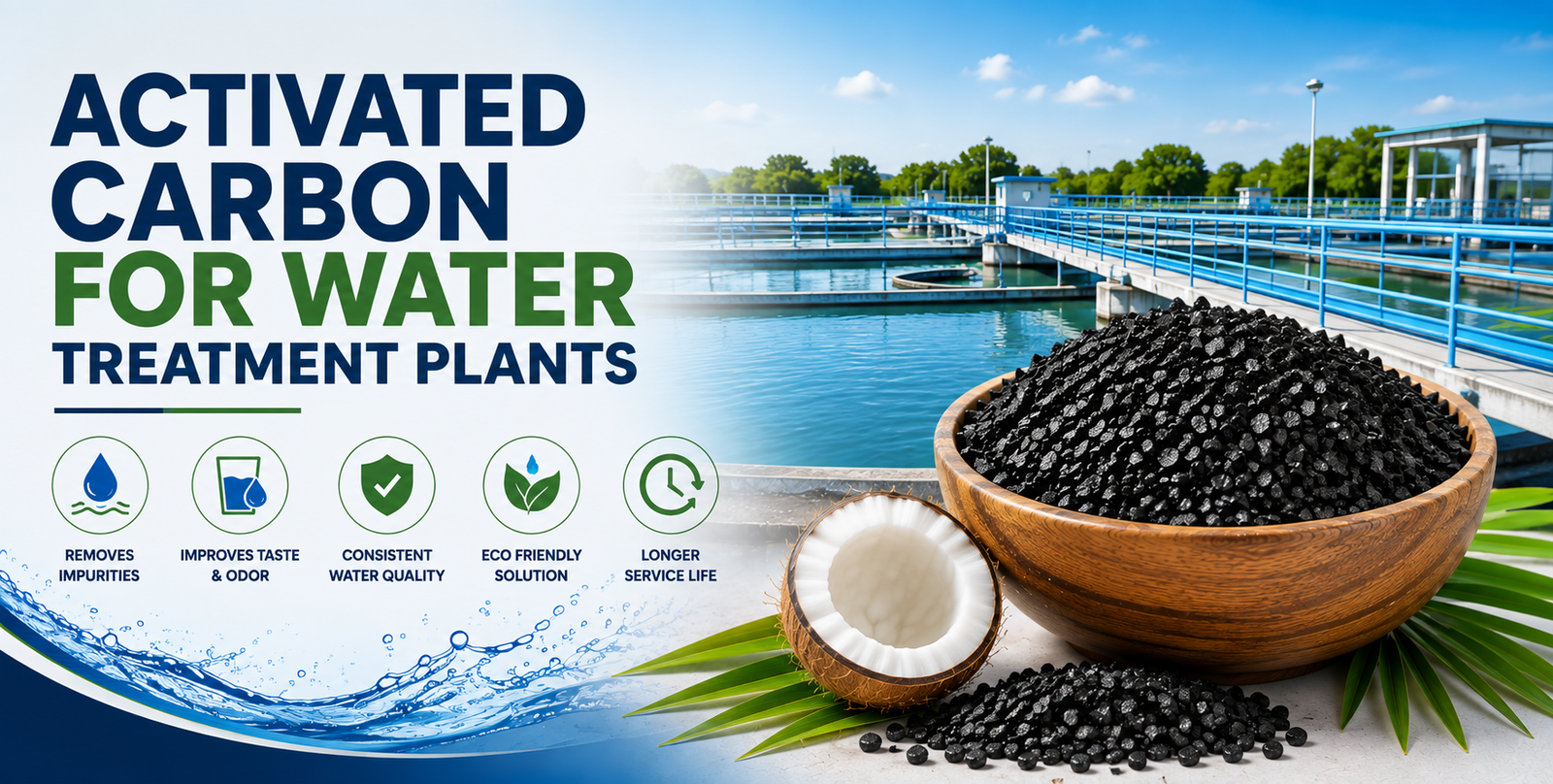
Activated carbon is widely used in water-treatment systems to adsorb contaminants that may not be adequately addressed through conventional filtration.Depending on the carbon grade, water chemistry, and operating conditions, activated carbon can help reduce chlorine, taste and odour compounds, dissolved organic contaminants, pesticides, volatile organic compounds (VOCs), colour-causing compounds, and selected industrial chemicals.Treatment performance depends on several factors, including pore structure, particle size, adsorption characteristics, contact time, flow rate, and contaminant concentration. Choosing an Activated Carbon Supplier for Water Treatment Plants therefore involves evaluating both the product specification and the manufacturer’s ability to supply it consistently.CG Carbon manufactures coconut shell activated carbon for municipal, industrial, and specialised water-treatment applications.
How Activated Carbon Works in Water Treatment
Activated carbon contains a highly porous internal structure that provides surface area for adsorption. As contaminated water comes into contact with the carbon, selected dissolved substances are adsorbed onto its internal surfaces.
Chlorine and residual disinfectants
Taste and odour compounds
Dissolved organic contaminants
Selected pesticides and herbicides
Volatile organic compounds
Colour-causing compounds
Selected industrial chemicals
There is no single activated carbon grade suitable for every treatment system. Carbon selection should therefore be based on the contaminants being treated and the operating conditions of the system.
Why Raw Material Matters
The characteristics of activated carbon begin with the raw material used in production. Coconut shell charcoal provides a dense carbon structure that can be developed through controlled activation.Raw-material characteristics such as density, hardness, and consistency can influence the physical properties of the finished activated carbon. CG Carbon sources coconut shell charcoal from South India and Sri Lanka, with attention to these characteristics.
Water-Treatment Applications
Municipal Water Treatment
Activated carbon can be used in municipal treatment systems to help reduce chlorine, taste, odour, pesticides, and selected organic contaminants.
Industrial Water Treatment
Industrial facilities may use activated carbon as part of process-water treatment, particularly where dissolved organic contaminants need to be reduced before downstream purification stages.
Wastewater Treatment and Reuse
Activated carbon may be incorporated into tertiary or advanced treatment processes to reduce selected dissolved organic contaminants before discharge or reuse. Its suitability depends on wastewater composition and the treatment objective.
Food and Beverage Process Water
Activated carbon can support the treatment of process water where taste, odour, colour, or selected organic impurities need to be controlled.
Pharmaceutical Process Water
In pharmaceutical applications, activated carbon may form one stage of a broader purification system. The grade should be selected according to the required purity, process conditions, and applicable specifications.
Power and Utility Water Treatment
Activated carbon can also be used in utility-water systems where chlorine or selected organic contaminants need to be reduced before subsequent treatment stages.
Selecting the Right Activated Carbon
The appropriate carbon grade should be selected according to the actual treatment requirement.
Target contaminants
Contaminant concentration
Iodine value or other relevant adsorption parameters
Hardness
Ash content
Moisture
Particle-size distribution
Bulk density
Contact time
Flow conditions
Water chemistry
Treatment-system configuration
A single specification should not be used in isolation when determining product suitability.
Conclusion
Choosing an Activated Carbon Supplier for Water Treatment Plants involves more than comparing prices or reviewing a standard specification.The suitability of the carbon, consistency between batches, manufacturing capability, and understanding of the treatment process all influence the effectiveness of a long-term supply arrangement.For water-treatment operators, the objective should be to select activated carbon according to the contaminants, system configuration, and required treatment outcome.
Frequently Asked Questions
1. How should activated carbon be selected for water treatment?
Selection should consider the target contaminants, water chemistry, contact time, flow rate, treatment configuration, and required performance.
2. What contaminants can coconut shell activated carbon help reduce?
Depending on the carbon grade and operating conditions, it can help reduce chlorine, taste and odour compounds, selected organic contaminants, pesticides, VOCs, and colour-causing compounds.
3. How often should activated carbon be replaced?
There is no universal replacement interval. Service life depends on contaminant loading, water quality, flow rate, contact time, and the amount of carbon used.
4. What is the difference between GAC and PAC?
Granular Activated Carbon (GAC) consists of larger particles generally used in fixed-bed systems.Powdered Activated Carbon (PAC) consists of finer particles that are typically dosed into the treatment stream and subsequently separated.
5. Can coconut shell activated carbon be used for wastewater treatment?
Yes, where the contaminants are suitable for adsorption. The appropriate grade should be selected according to wastewater characteristics and the required treatment outcome.
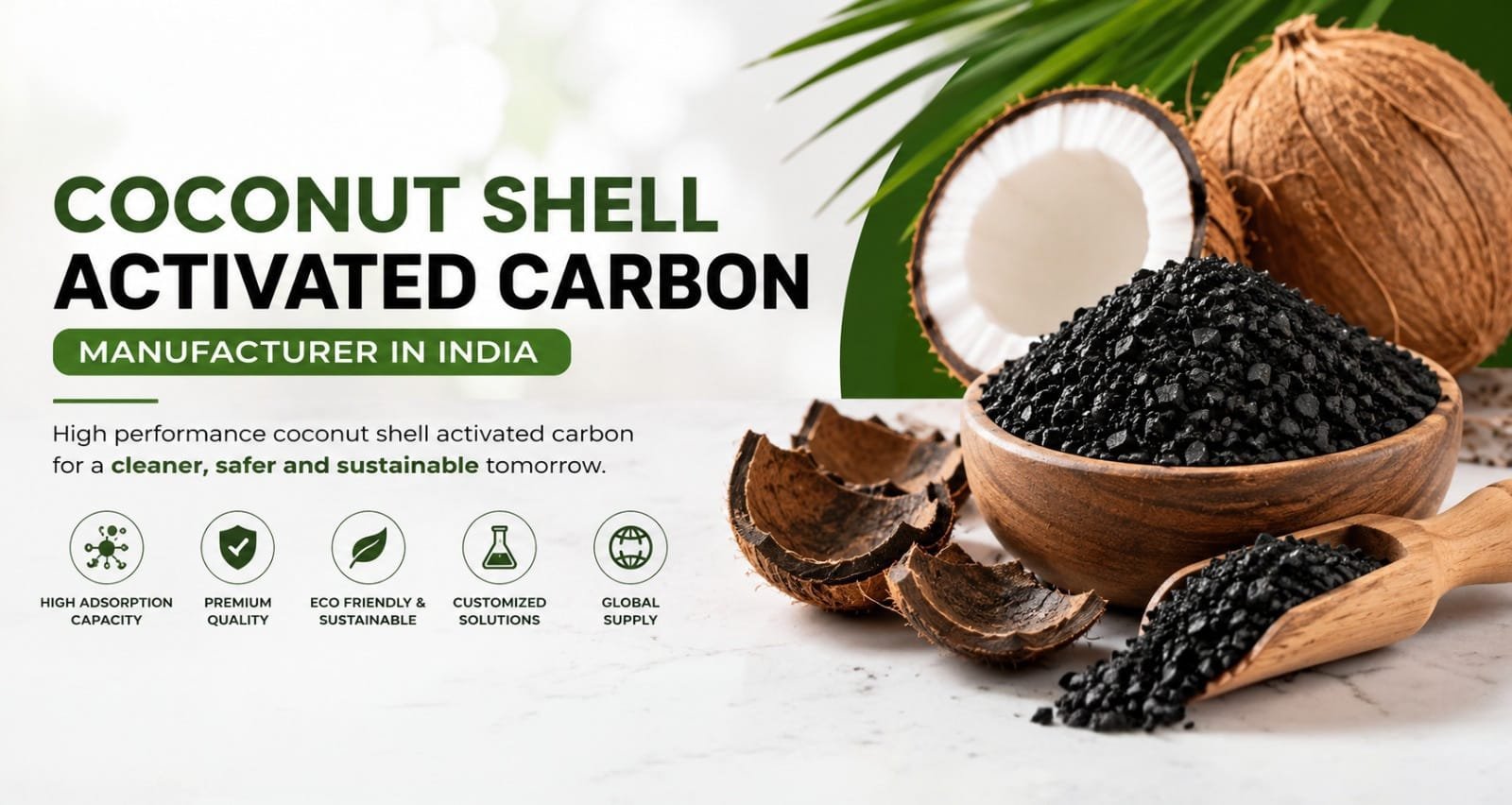
As industries increasingly focus on cleaner production, environmental responsibility, and efficient purification, the demand for high-quality activated carbon continues to grow. Among the different types available, coconut shell activated carbon is widely valued for its high adsorption capacity, hardness, low ash content, and renewable raw-material origin.India has emerged as an important manufacturing and export destination for activated carbon. For businesses sourcing from India, selecting the right Coconut Shell Activated Carbon Manufacturer in India is essential for achieving consistent product quality, reliable performance, and dependable supply.CG Carbon brings together coconut shell-based activated carbon, advanced technology, and application-focused expertise to address the purification requirements of diverse industries. Its R&D capabilities support the development of customised activated carbon solutions, while its focus on quality and sustainable manufacturing strengthens its position as a long-term partner for customers across different markets. CG Carbon’s approach focuses on developing solutions around these specific requirements, combining coconut shell-based products with technical expertise and customer-focused support.
Why Choose CG Carbon?
Choosing an activated carbon supplier is not simply about finding a product at the right price. Industries need a manufacturing partner that understands application requirements, maintains consistent quality, and provides dependable support throughout the supply process.CG Carbon combines carefully selected coconut shell raw materials, controlled manufacturing processes, quality testing, and application-focused expertise to supply activated carbon for diverse industrial requirements.Key advantages include:
Premium coconut shell raw materials
Controlled activation and manufacturing processes
Strict quality control and product testing
Customized product specifications
Bulk production capabilities
Technical support for product selection
Reliable export and logistics support
Consistent supply for domestic and international markets
With a focus on purity, performance, and trust, CG Carbon aims to provide activated carbon solutions that meet the specific needs of industries worldwide.
What Is Coconut Shell Activated Carbon?
Coconut shell activated carbon is produced from carbon-rich coconut shells through controlled carbonization and activation processes. During activation, millions of microscopic pores are developed within the carbon, creating a large internal surface area where contaminants can be adsorbed.Its physical and adsorption properties make it suitable for applications where filtration efficiency, mechanical strength, and purity are important.Coconut shell activated carbon is particularly valued for:
High adsorption capacity
Well-developed microporous structure
Superior hardness
Low ash content
Excellent mechanical strength
Good resistance to particle breakdown
Renewable raw-material origin
These characteristics make it a valuable filtration medium across a wide range of industrial applications.
Why India Is a Leading Manufacturer of Coconut Shell Activated Carbon
India’s established coconut-processing sector, manufacturing capabilities, skilled workforce, and export infrastructure have supported the growth of its activated carbon industry.Coconut shells, which are renewable agricultural by-products, can be converted into high-value activated carbon through controlled manufacturing processes. Indian manufacturers also invest in activation technology, grading, testing, and quality control to develop carbon grades for different industrial applications.For international buyers, India’s combination of raw-material availability, manufacturing expertise, and export capabilities makes it an important sourcing destination for activated carbon.
Key Features of Coconut Shell Activated Carbon
High Adsorption Capacity
The highly porous structure of coconut shell activated carbon provides numerous adsorption sites. This enables it to capture various organic compounds, odors, chemicals, and other impurities from liquids and gases.
Superior Hardness and Mechanical Strength
Coconut shell activated carbon is known for its strong physical structure. Its hardness helps minimize particle breakdown during transportation and continuous operation, reducing dust formation and carbon loss.This characteristic is particularly important in demanding applications such as gold recovery, where carbon can undergo repeated agitation, screening, pumping, elution, and regeneration.
Low Ash Content
Lower ash content helps reduce unwanted mineral residue during filtration. This makes coconut shell activated carbon suitable for applications where product purity and cleaner filtration are important.
Renewable Raw Material
Coconut shells are a renewable agricultural by-product. Converting them into activated carbon makes productive use of this resource while supporting more responsible material utilization.
Industrial Applications of Coconut Shell Activated Carbon
The versatility of coconut shell activated carbon allows it to support purification and filtration processes across several industries.
Water Treatment
Activated carbon is widely used in water treatment to reduce chlorine, pesticides, dissolved organic contaminants, taste, and odor.Common applications include:
Municipal water treatment
Industrial water purification
Wastewater treatment
RO pre-filtration
Drinking water systems
The appropriate carbon grade depends on water quality, target contaminants, flow conditions, and the overall treatment system.
Air and Gas Purification
Activated carbon can adsorb volatile organic compounds (VOCs), chemical vapors, industrial odors, and selected gases from air and exhaust streams.It is used in:
HVAC systems
Manufacturing facilities
Laboratories
Industrial emission control
Environmental control systems
The required carbon grade depends on the type and concentration of contaminants, operating temperature, airflow, and contact conditions.
Food & Beverage Industry
Food-grade activated carbon is used in purification and decolorization processes where unwanted color, odor, and organic impurities need to be reduced.Common applications include:
Sugar refining
Edible oil purification
Beverage clarification
Food ingredient purification
Decolorization processes
Product specifications should be selected according to the material being treated and the required purification outcome.
Pharmaceutical Industry
Purity is critical in pharmaceutical manufacturing. Activated carbon can support impurity removal during different stages of pharmaceutical production.Applications include:
API purification
Solvent recovery
Chemical purification
Pharmaceutical intermediates
Water purification
The carbon used in pharmaceutical applications must be selected according to the process, purity requirements, and applicable specifications.
Oil & Gas Industry
The oil and gas sector uses activated carbon in several purification and recovery applications, including:
Natural gas purification
Mercury removal
Hydrocarbon recovery
VOC control
Refinery filtration
The specific activated carbon grade is selected according to process requirements and the contaminants involved.
Gold Recovery
Coconut shell activated carbon is widely used in CIP, CIL, and CIC gold recovery because of its strong adsorption, microporous structure, hardness, and attrition resistance.
Why It Is Preferred for CIP, CIL and CIC
High adsorption performance
Good hardness and durability
Suitable pore structure
Consistent particle size
How to Choose the Right Coconut Shell Activated Carbon Manufacturer in India
Selecting a manufacturer should involve more than comparing product prices. The consistency and suitability of activated carbon can directly affect filtration efficiency, maintenance requirements, carbon consumption, and overall operating performance.
Manufacturing Experience
An experienced manufacturer understands the relationship between raw-material quality, activation conditions, particle size, and final product performance.
Quality Assurance
Manufacturers should have appropriate testing and quality-control procedures for parameters such as:
Adsorption capacity
Moisture content
Ash content
Particle size
Hardness
Bulk density
Application-specific performance parameters
Customized Solutions
Different industries have different purification requirements. A reliable manufacturer should be able to provide suitable grades or specifications based on the customer’s application.Customization may involve:
Particle size
Adsorption characteristics
Hardness requirements
Moisture specifications
Application-specific parameters
Packaging requirements
Technical Expertise
Technical support can help customers identify the appropriate activated carbon grade based on contaminants, operating conditions, filtration systems, recovery processes, and required performance.This is particularly important for gold-recovery plants, where carbon selection needs to align with the specific CIP, CIL, or CIC circuit.
Export Capability
For international buyers, manufacturing capability should be supported by reliable packaging, documentation, logistics, and delivery systems.A manufacturer with established export capabilities can help simplify procurement and maintain a more predictable supply chain.
Advantages of Partnering with CG Carbon
For industrial buyers, a dependable supplier should provide more than a standard activated carbon product. Consistency, technical understanding, customization, and supply reliability are equally important.CG Carbon offers:
Premium coconut shell activated carbon
Advanced manufacturing processes
Consistent quality control
Customized product specifications
Bulk production capabilities
Technical assistance
Export and logistics support
Reliable global supply
These capabilities enable CG Carbon to support customers with different technical requirements and procurement volumes while maintaining a focus on product quality and consistency.
The Future of Coconut Shell Activated Carbon
The demand for efficient purification solutions is witnessing steady growth industries focus on environmental compliance, cleaner production, and resource efficiency.Water treatment, air purification, gold recovery, environmental remediation, and other advanced applications are likely to create continued demand for high-performance activated carbon.The future of the industry will increasingly depend on manufacturers that can combine:
Consistent product quality
Advanced activation technology
Application-specific solutions
Responsible raw-material sourcing
Reliable production capacity
Technical expertise
Strong global supply capabilities
Manufacturers that combine these capabilities will be well positioned to support the evolving requirements of industrial buyers.
Conclusion
Coconut shell activated carbon offers a strong combination of adsorption performance, hardness, low ash content, and renewable origin. These characteristics make it an effective filtration medium for water treatment, air purification, food and beverage processing, pharmaceuticals, oil and gas, gold recovery, and other industrial applications.For gold-recovery operations, carbon quality can influence adsorption performance, carbon retention, regeneration requirements, and overall process efficiency. Understanding factors such as pore structure, hardness, attrition, fouling, regeneration, and circuit configuration helps gold plants make more informed purchasing decisions.For businesses sourcing from India, choosing a reliable Coconut Shell Activated Carbon Manufacturer in India is essential for maintaining consistent performance and dependable supply.With its focus on premium coconut shell activated carbon, controlled manufacturing, quality standards, customized specifications, and global supply support, CG Carbon provides reliable solutions for industries seeking efficient and high-performance purification products.
Frequently Asked Questions
1. What is coconut shell activated carbon, and where is it used?
Coconut shell activated carbon is used across a variety of purification, filtration, and recovery applications. Common uses include water and wastewater treatment, air and gas purification, food and beverage processing, pharmaceutical applications, oil and gas purification, gold recovery, and other industrial processes.
2. What makes coconut shell activated carbon different from coal-based activated carbon?
Coconut shell activated carbon is known for its high hardness, relatively low ash content, and well-developed microporous structure. These characteristics make it suitable for applications where strong adsorption performance, physical durability, and cleaner filtration are important.
3. Which industries commonly use coconut shell activated carbon?
It is used across water and wastewater treatment, air purification, food and beverage processing, pharmaceutical manufacturing, oil and gas, gold recovery, automotive applications, tobacco processing, and environmental treatment.
4. Why is raw-material selection important in activated carbon manufacturing?
The characteristics of the raw material form the basis of the final activated carbon. For coconut shell activated carbon, the quality, density, and physical characteristics of the coconut shell material can influence the properties developed during carbonization and activation.
5. Can activated carbon be customized for specific industrial applications?
Yes. Activated carbon requirements vary depending on the contaminants being treated, process conditions, filtration equipment, and desired performance. Manufacturers may provide different grades or specifications to better match specific operating requirements.
6. How should buyers determine the right activated carbon grade?
The appropriate grade should be selected based on the intended application rather than a single specification. Factors such as contaminant type, concentration, contact time, flow conditions, particle size, hardness, and the treatment system should be considered.
7. Why is batch-to-batch consistency important in activated carbon?
Consistent product quality helps maintain predictable process performance. Variations in properties such as particle size, hardness, moisture, ash content, or adsorption characteristics can affect treatment or recovery results.
8. Why is coconut shell activated carbon widely used in gold recovery?
Its microporous structure provides adsorption sites for gold-containing species, while its physical hardness helps the carbon withstand the demanding conditions involved in gold recovery. It can therefore be used in processes such as CIP, CIL, and CIC.
9. What is the difference between CIP, CIL, and CIC?
Carbon-in-Pulp (CIP) generally involves leaching followed by adsorption of dissolved gold onto activated carbon. Carbon-in-Leach (CIL) combines leaching and adsorption within the same circuit. Carbon-in-Column (CIC) uses activated carbon in columns to recover gold from a gold-bearing solution.
10. Which activated carbon properties are important for gold recovery?
Gold-recovery operations should consider properties such as adsorption capacity, pore structure, hardness, attrition resistance, particle size distribution, ash content, moisture, and batch-to-batch consistency. The importance of each property depends on the specific recovery circuit.
11. Why does activated carbon become fouled during gold recovery?
Fouling can occur when oils, organic compounds, suspended solids, precipitates, and other unwanted materials accumulate on the carbon or interfere with its pore structure. Solution chemistry and operating conditions can also influence the extent of fouling.
12. Can fouled activated carbon be treated and reused?
Yes. Depending on its condition, activated carbon can undergo processes such as acid washing and thermal reactivation to remove certain accumulated contaminants and recover part of its adsorption capacity. The appropriate treatment depends on the type of fouling and operating conditions.